Tax Free Threshold Australia 2025–26: What It Is, Who Gets It and How to Claim It

The tax free threshold is the amount of income you can earn each financial year before you start paying income tax in Australia. For 2025–26 it is $18,200. Earn less than this and you pay nothing. Earn more and you only pay tax on the amount above $18,200 — not the entire income.
It sounds simple. But the way you claim it — or fail to claim it — has a direct effect on how much tax your employer withholds from every pay, and how large your tax refund is at the end of the year.
Disclaimer: This article is general information only and does not constitute tax advice. Consult a registered tax agent or visit the ATO for advice specific to your circumstances.
At a glance
| Tax free threshold 2025–26 | $18,200 |
| Low income tax offset (LITO) effective threshold | Up to $37,500 effectively tax-free with maximum LITO |
| Who can claim it | Australian tax residents |
| Who cannot claim it | Foreign residents, working holiday makers (417/462), most temporary visa holders |
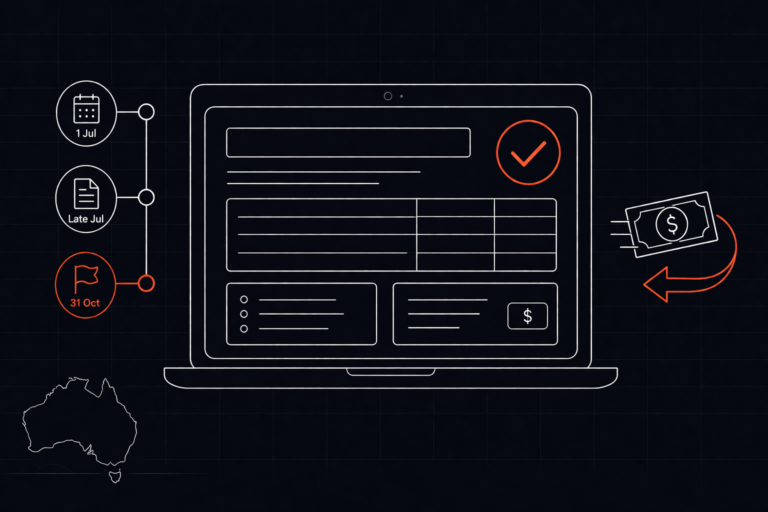
| Where to claim it | TFN declaration form — tick “Yes” to the tax free threshold question |
| Claim with multiple jobs | Only one employer at a time |
What is the tax free threshold?
The tax free threshold means the first $18,200 of your income each financial year is not taxed. It applies automatically to Australian residents — but only if you tell your employer to apply it by ticking the correct box on your Tax File Number (TFN) declaration form.
For 2025–26 the Australian resident tax rates are:
| Income | Tax rate |
|---|---|
| $0 – $18,200 | 0% (tax free threshold) |
| $18,201 – $45,000 | 19% |
| $45,001 – $120,000 | 32.5% |
| $120,001 – $180,000 | 37% |
| $180,001 and above | 45% |
Source: ATO individual tax rates 2025–26 — see also Australia tax rates 2026 and the ATO tax brackets 2026–27 for the changes that take effect from 1 July 2026.
These rates apply to your taxable income — that is, your income minus any deductions you are entitled to claim. The threshold itself does not change when you claim deductions; it always sits at $18,200 per financial year.
How the Low Income Tax Offset extends the effective threshold
The tax free threshold of $18,200 is the baseline figure. But the Low Income Tax Offset (LITO) extends the effective point at which most low-income earners begin paying tax to approximately $18,200 to $37,500, depending on income.
The LITO for 2025–26 is:
| Income | LITO amount |
|---|---|
| $18,200 or below | $700 (maximum) |
| $18,201 – $37,500 | $700 — reduces by 5 cents for every $1 above $18,200 |
| $37,501 – $45,000 | $325 — reduces by 1.5 cents for every $1 above $37,500 |
| $45,001 and above | Nil |
In practice this means a resident earning $22,575 pays effectively zero net tax after the LITO offsets the 19% liability on the income between $18,200 and $22,575. The interaction between the threshold and the LITO is calculated automatically when you lodge your tax return — you do not need to calculate it yourself.
For higher incomes, the Low and Middle Income Tax Offset (LMITO) no longer applies from 2024–25 onward, having been removed after the Stage 3 tax cuts took effect.
Who can claim the tax free threshold?
You can claim the tax free threshold if you are an Australian tax resident for the full financial year. If you became a resident partway through the year — for example you arrived in Australia in January 2026 — you can still claim the threshold, but it is proportionally reduced to the months you were a resident.
Who cannot claim it
Foreign residents: If you are a foreign resident for tax purposes, you are not entitled to the tax free threshold. Foreign residents pay tax from the first dollar at the foreign resident rates. For how tax residency is determined, see the Australian tax residency test.
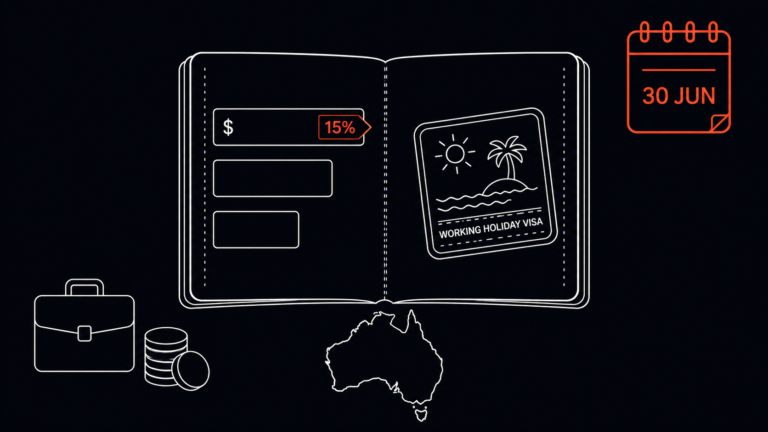
Working holiday makers (417/462 visas): WHMs pay a flat 15% rate on all Australian income with no tax free threshold. See working holiday visa tax 2025–26.
Temporary visa holders without Medicare access: Most temporary visa holders are foreign residents for tax purposes and cannot claim the threshold. However, some — particularly those on employer-sponsored visas living permanently in Australia for an extended period — may be assessed as tax residents. See the Medicare levy for visa holders guide for how residency status and Medicare interact.
How to claim the tax free threshold
You claim the tax free threshold through your Tax File Number (TFN) declaration form, which you complete when starting a new job. The form has one key question:
“Do you want to claim the tax free threshold from this payer?”
- Answer Yes if this is your only job or your main job (the one where you earn the most)
- Answer No if you have another job where you are already claiming it, or if you are a foreign resident or WHM
Your employer uses your answer to determine which withholding scale to apply to your pay. If you tick Yes, they withhold less tax from each pay. If you tick No, they withhold more.
You can only claim the threshold with one employer at a time — not simultaneously with two or more employers.
What if you have two jobs?
This is one of the most common tax mistakes in Australia. If you work two jobs simultaneously and claim the tax free threshold with both employers:
- Employer A withholds as if your entire income is below $18,200
- Employer B also withholds as if your entire income is below $18,200
- Your combined income is above the threshold — but neither employer knows about the other
- At tax return time the ATO combines all income and you owe tax you were not withheld for
The rule: Claim the tax free threshold with your main employer (typically the one where you earn the most). With your second employer, tick No to the threshold question.
If you do accidentally claim the threshold with two employers, the ATO catches this at tax return time. You will owe the under-withheld tax with interest. It is not treated as fraud — it is a common administrative error — but it does result in a tax debt rather than a refund.
What if you don’t claim it and you should?
If you start a new job and mistakenly tick No to the threshold question when you are a resident and it is your only job, your employer withholds tax at a higher rate than necessary.
Example: Emma earns $52,000 at her only job. She accidentally ticks No.
- Her employer withholds as if the entire $52,000 is taxable from dollar one
- Extra tax withheld throughout the year: approximately $3,458
- At tax time Emma lodges her return, claims the threshold correctly, and receives most of this back as a refund
The refund process works — but it means Emma has been lending money to the ATO interest-free all year. The better approach is to provide a new TFN declaration ticking Yes as soon as you realise the error. Your employer updates the withholding from the next pay cycle.
Part-year residents: the pro-rata threshold
If you were a tax resident for only part of the 2025–26 financial year — because you arrived in Australia partway through the year — your tax free threshold is calculated pro-rata.
Formula: $13,464 + ($4,736 × months as a resident ÷ 12)
For example, if you arrived on 1 January 2026 and were a resident for 6 months of the 2025–26 year:
- $13,464 + ($4,736 × 6 ÷ 12) = $13,464 + $2,368 = $15,832 threshold
The ATO calculates this automatically when you lodge your return and declare your period of Australian residency. You do not need to do the calculation manually — but understanding it helps you anticipate whether you will receive a refund or owe tax.
The tax free threshold and superannuation
Superannuation contributions from your employer do not count toward the tax free threshold. The threshold applies to your ordinary taxable income — your wages, salary, investment income, business income and government payments.
Employer super contributions (12% of your ordinary time earnings from 1 July 2025) are contributed to your super fund separately and taxed at 15% inside the fund — not part of your personal income tax calculation. For context on superannuation rates, see superannuation balance Australia 2026.
If you make voluntary personal contributions to super and intend to claim a tax deduction for them, those deductions reduce your taxable income — which means the effective value of the threshold increases proportionally.
The tax free threshold and HECS-HELP
If you have a HECS-HELP debt, compulsory repayments kick in once your income exceeds the minimum repayment threshold — $54,435 for 2025–26. This is separate from the income tax free threshold of $18,200.
Between $18,200 and $54,435, you pay income tax (offset by LITO) but no compulsory HECS-HELP repayments. Above $54,435, both income tax and HECS-HELP repayments apply simultaneously.
The 2026–27 threshold: is it changing?
The tax free threshold itself — $18,200 — has not changed since 2012 when it was increased from $6,000. The government has not announced any change to the threshold amount for 2026–27.
However, the tax brackets above $18,200 are changing from 1 July 2026 as part of the Stage 3 tax cuts implementation. The 19% bracket (currently applying to $18,201–$45,000) remains unchanged, but the rates on higher income bands shift. For the full 2026–27 breakdown see ATO tax brackets 2026–27.
Frequently asked questions
What is the tax free threshold for 2025–26?
$18,200. This means the first $18,200 of taxable income for Australian tax residents is not subject to income tax.
Does the tax free threshold apply to all types of income?
Yes — it applies to wages, salary, investment income, business income and most other Australian-sourced taxable income. Some types of income have specific withholding rules (franking credits, rental income) but the threshold still applies to your total taxable income when your return is assessed.
Can I claim the tax free threshold if I’m on a partner visa bridging visa?
If your visa status makes you an Australian tax resident — which most partner visa holders are — yes, you can claim the threshold. See SC 820/801 onshore partner visa 2026 for more on how the bridging visa interacts with residency.
I forgot to claim the threshold when I started my job. What do I do?
Complete a new TFN declaration form ticking Yes and give it to your employer. They will adjust your withholding from the next pay cycle. Any over-withheld tax from prior pay periods will be refunded when you lodge your annual tax return.
Does the threshold reset each financial year?
Yes. The $18,200 threshold applies fresh each financial year (1 July to 30 June). It does not carry over or accumulate if you earned less than $18,200 in a prior year.
If I earn $18,200 exactly, do I pay any tax?
No. The threshold is $18,200 — income at or below this amount attracts a 0% tax rate. Tax begins on the dollar above $18,200 at 19 cents per dollar.
This article is general information only and does not constitute tax advice. Tax obligations depend on individual circumstances including residency status, income type and visa conditions. Consult a registered tax agent or visit the ATO for guidance specific to your situation.
Sources: ATO individual tax rates 2025–26 | ATO Low Income Tax Offset | ATO tax free threshold