
The RBA’s interest rate decisions in 2026 have already reversed the direction of monetary policy — catching many borrowers off guard after a period of rate cuts in 2025. This article tracks every decision, the data that drove it, and what the remaining 2026 meeting schedule means for Australian households and businesses.
Where Rates Stood Coming Into 2026
To understand the 2026 decisions, you need the 2025 context.
The February 2026 hike marked the first time the RBA had increased the official cash rate since November 2023, which was followed by an extended period of cash rate holds — at 4.35% — before delivering three rate cuts in February, May, and August 2025.
Those three cuts brought the cash rate down from 4.35% to 3.60% by August 2025. The logic at the time was straightforward: inflation had been falling, and the RBA judged that some easing in financial conditions was appropriate to support growth.
That logic unravelled in the second half of 2025.
While inflation had fallen substantially since its peak in 2022, it picked up materially in the second half of 2025. Growth in private demand strengthened substantially more than expected, driven by both household spending and investment. Activity and prices in the housing market were also continuing to pick up. Financial conditions eased over 2025 and it was uncertain whether they remained restrictive.
By the time the Board met in February 2026, the data made a hold untenable.
2026 RBA Cash Rate Decisions — Full Timeline
| Meeting Date | Decision | Cash Rate | Vote |
|---|---|---|---|
| 3 February 2026 | +25bp (hike) | 3.85% | Unanimous |
| 17 March 2026 | +25bp (hike) | 4.10% | 5–4 majority |
| April 2026 | No meeting | 4.10% (unchanged) | — |
| 5 May 2026 | ⏳ Next decision | TBC | Scheduled |
| June 2026 | TBC | TBC | Scheduled |
| September 2026 | TBC | TBC | Scheduled |
| November 2026 | TBC | TBC | Scheduled |
| December 2026 | TBC | TBC | Scheduled |
Source: Reserve Bank of Australia — Monetary Policy Decisions 2026
The RBA moved to an eight-meeting-per-year structure in 2024, down from eleven. That means each decision carries more weight, and the gaps between meetings are longer — giving the Board more time to assess data, but also leaving borrowers in uncertainty for longer stretches.
February 2026 — The Pivot Nobody Wanted
Decision: Cash rate increased 25bp to 3.85% Vote: Unanimous
The February hike made Australia the first major central bank to go from rate cuts to rate hikes following the post-COVID inflation spike.
The unanimous vote was notable. It signalled there was no dissent within the Board — the inflation data had been clear enough that every member agreed action was needed.
The key drivers cited by the RBA were:
- Inflation picking up in the second half of 2025
- Private demand growing faster than expected
- Capacity pressures greater than previously assessed
- Labour market conditions described as “a little tight”
The RBA’s near-term forecasts for inflation were upgraded noticeably, reflecting this assessment. Trimmed mean inflation was forecast at 3.7% for the year to June 2026, up from 3.2% previously. Inflation was not expected to return toward the middle of the 2–3% target range until the end of the forecast horizon in mid-2028.
That last point deserves attention. The RBA was not signalling a quick fix. It was telling markets and households: rates are going up, and they are staying up for a long time.
March 2026 — The Follow-Up Hike
Decision: Cash rate increased 25bp to 4.10% Vote: 5–4 majority
The Reserve Bank increased official interest rates for the second month in a row as war in the Middle East compounded inflation concerns. In a split five-four decision, the monetary policy board lifted the cash rate following a hike of the same size in February.
The split vote is important context. Four Board members voted to hold. That is not a comfortable majority, and it tells you the Board is not running on autopilot — there is genuine disagreement about how far rates need to go.
The addition of a new factor — the conflict in the Middle East resulting in sharply higher fuel prices — was flagged as a material risk that inflation would remain above target for longer than previously anticipated.
What the March Minutes Said
Australia’s inflation remains elevated, with excess demand persisting, according to the RBA’s March minutes. Rising oil prices, driven by Middle East tensions, were flagged as a key near-term inflation driver, lifting short-term expectations, though longer-term ones stayed anchored. Higher energy costs are expected to weigh on growth domestically and globally, though the scale of impact is uncertain. Policymakers noted financial conditions have tightened slightly but questioned how restrictive current settings are.
The Board was essentially saying: we have tightened, but we do not yet know if we have tightened enough.
April 2026 — No RBA Meeting
There was no RBA cash rate decision in April 2026.
The Reserve Bank moved to an eight-meetings-per-year schedule in 2024, and April is not a scheduled meeting month. The Board met in March and does not meet again until May.
The cash rate remains at 4.10% — unchanged since the 17 March 2026 decision.
The next scheduled monetary policy decision is 5 May 2026, when the Board meets at 2:30pm AEST. This will be the most closely watched decision of the year so far, because the March quarter CPI data — due for release on 29 April 2026 — will be available to the Board for the first time. That data is the single most important input for the May decision.
If March quarter trimmed mean inflation accelerates further, a third consecutive hike becomes more likely. If it shows signs of easing, the Board may hold at 4.10% and reassess.
What Is Driving the 2026 Rate Hikes?
Three forces are running simultaneously, and the RBA is trying to respond to all three.
1. Inflation Above Target
The RBA’s target band is 2–3%. Underlying trimmed mean inflation rose 0.9% over the December quarter and 3.4% over the year — well above the midpoint, and moving in the wrong direction after the 2025 cuts. For the full picture of price pressures across the economy, see our guide to things getting more expensive in Australia in 2026.
2. A Tight Labour Market
The unemployment rate has been a little lower than expected and measures of labour underutilisation remain at low rates. Growth in the Wage Price Index has eased from its peak, but broader measures of wages growth continue to be strong and growth in unit labour costs remains high.
A tight labour market means workers have pricing power. That feeds into wages, which feeds into services inflation — the stickiest component to bring down.
3. The Global Supply Shock
RBA Assistant Governor Chris Kent said the shock from the Middle East conflict could both push short-run neutral rates higher and necessitate a more restrictive stance of policy. He cautioned that the longer the conflict endures, the greater the economic fallout and risk of asset repricing.
This is significant. A supply shock — oil prices rising because of a war, not because of domestic demand — is particularly difficult for a central bank to respond to. Raising rates cannot fix a supply disruption. What it can do is prevent the initial price surge from embedding into long-term inflation expectations.
Impact on Household Budgets
The cash rate does not directly set mortgage rates, but it heavily influences them. Every major bank passed on both the February and March increases in full.
Variable Rate Mortgage Impact
On a $600,000 variable rate mortgage with 25 years remaining, a 0.50% increase in the interest rate adds approximately $165–$180 per month to repayments. For the full breakdown of how rates translate into repayments across different loan sizes, see our RBA cash rate and mortgage repayments guide.
Combined with the earlier 2022–2023 hiking cycle — where the cash rate went from 0.10% to 4.35% — many households have absorbed multiple years of rate pressure.
| Cash Rate Point | Rate | Cumulative change since May 2022 |
|---|---|---|
| May 2022 (pre-hike era) | 0.10% | — |
| November 2023 (peak) | 4.35% | +4.25% |
| August 2025 (post-cuts) | 3.60% | +3.50% |
| March 2026 (current) | 4.10% | +4.00% |
Source: RBA Cash Rate Target data
The August 2025 relief from rate cuts was short-lived. Effective rates are now only 25 basis points below the 2023 peak.
Fixed Rate Borrowers
Borrowers who locked in low fixed rates during 2020–2022 and have since rolled onto variable are facing the full brunt. This is the so-called fixed rate cliff — and many Australian households are still in the middle of it. For the broader picture of how this is affecting Australian homeowners, see our Australia mortgage stress 2026 guide.
What to Watch Before the May 2026 Decision
The May 5 decision will be shaped primarily by two data releases between now and then:
1. March quarter CPI — 29 April 2026 This is the big one. The Board will have the full Q1 2026 inflation picture for the first time. If trimmed mean inflation comes in above 3.5%, another hike is likely. If it shows meaningful deceleration, the Board may pause.
2. Labour market data — April 2026 Employment and unemployment figures for April, released in mid-May, will arrive too late for the May decision but will set the tone for June.
The four dissenting Board members in March voted to hold — not to cut. Even the doves are not calling for easing. The realistic range for 2026 remains: hold at 4.10%, or one further hike. Cuts are not on the table for the foreseeable future based on current RBA guidance.
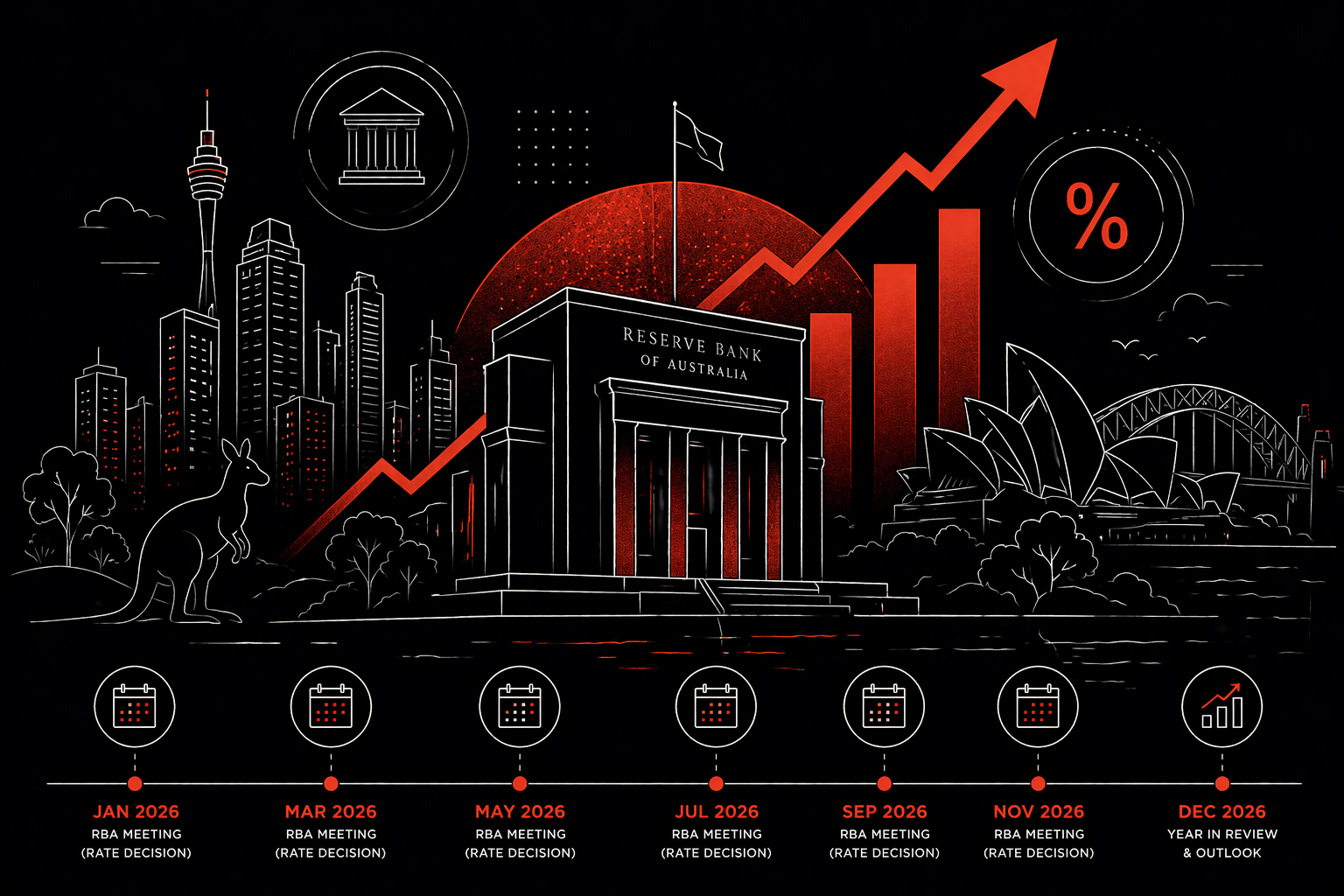
Full RBA Meeting Schedule 2026
| Meeting | Decision date | Status |
|---|---|---|
| February | 3 February 2026 | Hiked to 3.85% |
| March | 17 March 2026 | Hiked to 4.10% |
| April | No meeting | — |
| May | 5 May 2026 | ⏳ Next decision |
| June | TBC | Scheduled |
| September | TBC | Scheduled |
| November | TBC | Scheduled |
| December | TBC | Scheduled |
Source: RBA Board Meeting Schedules
FAQ
What is the RBA cash rate right now in April 2026?
The official cash rate is 4.10%, unchanged since 17 March 2026. There was no April meeting — the RBA does not meet every month. The next decision is 5 May 2026.
Was there an RBA meeting in April 2026?
No. The RBA moved to eight meetings per year in 2024. April is not a scheduled meeting month. The Board met in March and does not meet again until May.
When is the next RBA decision after April 2026?
The next decision is 5 May 2026 at 2:30pm AEST. The March quarter CPI data, released on 29 April, will be the key input for that decision.
Why did the RBA raise rates in 2026?
Inflation picked up materially in the second half of 2025 after three rate cuts brought the cash rate to 3.60%. The RBA judged that private demand was growing faster than expected and that capacity pressures were greater than previously assessed — pushing inflation back above the 2–3% target band. The Middle East conflict added further pressure through higher fuel prices.
Will the RBA raise rates again in May 2026?
It depends on the March quarter CPI data released 29 April. If underlying inflation continues to accelerate, a third hike is likely. If it shows signs of easing, the Board may hold. Economists are divided — Finder’s panel of 40+ economists describes it as a close call.
Will the RBA cut rates in 2026?
Based on current RBA guidance, rate cuts in 2026 appear unlikely. The RBA’s own projections do not see trimmed mean inflation returning toward the middle of the 2–3% target band until mid-2028. The Board has signalled a data-dependent approach but the risk is skewed toward further hikes, not cuts.
How does the cash rate affect my mortgage?
The cash rate sets the floor for variable lending rates. When the RBA raises the cash rate, banks typically increase variable mortgage rates by the same amount. Both the February and March 2026 hikes were passed on in full by all major banks. Fixed rates are priced separately based on bond market expectations.
How many times does the RBA meet in 2026?
Eight times. Two decisions have been made — February and March. The remaining six meetings are in May, June, September, November, and December.
Conclusion
The RBA cash rate is 4.10% as of April 2026, following two consecutive hikes in February and March. There was no April meeting — the next decision is 5 May 2026, and the March quarter CPI data on 29 April will determine whether the Board hikes a third time or holds. For households and businesses, the most important thing to understand is this: the 2025 cuts are effectively undone, and the path back to lower rates runs through lower inflation — not a timeline.
This article is for informational purposes only and does not constitute financial advice. Data is sourced from publicly available RBA and Australian government sources. Always consult a registered financial adviser for advice specific to your situation.