

US tariffs on Australia in 2026 are not the clean 10 per cent story they appeared to be in early April 2025. Twelve months on from “Liberation Day,” the tariff landscape has been reshaped by a Supreme Court ruling, a new presidential surcharge, exemptions that protect Australia’s biggest export, and two active investigations that could produce more punitive outcomes by July. This article sets out where things actually stand — based on publicly available data from the Department of Foreign Affairs and Trade and official Australian export statistics — and what it means for Australian exporters, businesses and households.
How We Got Here — The Full Timeline
Understanding the current position requires knowing how rapidly it has shifted.
April 2025 — Liberation Day. President Trump declared a national emergency under the International Emergency Economic Powers Act (IEEPA) and imposed sweeping reciprocal tariffs on imports from most countries. Australia was assigned a 10 per cent rate — lower than the 34 per cent on China, 46 per cent on Vietnam and 20 per cent on the EU. Australia’s relatively low bilateral trade surplus with the US was cited as justification.
August 2025 — De minimis suspended. The US suspended its de minimis exemption, which had previously allowed goods valued at US$800 or less to enter duty-free. From 29 August 2025, all goods — including small online purchases — became subject to tariff rates. This was subsequently extended on 20 February 2026.
February 2026 — Supreme Court ruling. In a 6-3 decision, the US Supreme Court struck down the IEEPA-based reciprocal tariffs, ruling that the legislation did not give the president power to impose tariffs. The ruling terminated the original Liberation Day rates. Within days, President Trump introduced a new 10 per cent global Temporary Import Surcharge under different legal authority — the Trade Act of 1974, Section 122 — and subsequently raised it to 15 per cent. The 15 per cent rate is the current operative level for most Australian goods, applied for up to 150 days while the administration pursues further legislative authority.
March 2026 — Section 301 investigations launched. The Trump administration opened two new trade investigations. The first targets countries with alleged excess manufacturing capacity. The second assesses whether trading partners — including Australia — are sufficiently enforcing laws against importing goods made with forced labour. Both investigations are expected to conclude in July 2026. Any resulting tariff measures would be specific to the findings and could be more punitive than the current surcharge.
What Australia Exports to the United States
The scale of Australia’s exposure to US tariff policy depends on what we actually send there.
Australia exported approximately $24.8 billion in goods to the United States in 2025, according to UN COMTRADE data. The United States is not Australia’s largest export market — China holds that position by a wide margin for commodities — but it is a significant destination, particularly for agricultural produce.
| Australian Export to the US | Estimated Value (2024-25) | Current Tariff Status |
|---|---|---|
| Beef and red meat | ~$4.1 billion | Beef tariff-exempt (AUSFTA quota); sheepmeat 15% |
| Pharmaceutical products | ~$1.2 billion | Currently 15% surcharge; sector review ongoing |
| Aluminium | Significant | 25% (Section 232, separate to surcharge) |
| Steel products | Smaller volume | 25% (Section 232) |
| Wine and beverages | ~$303 million | 15% surcharge |
| Gold | Meaningful | Generally exempt |
| Seafood and other agricultural | Various | 15% surcharge |
Sources: US-Australia bilateral trade data (UN COMTRADE 2025); DFAT trade data. Beef value from Meat & Livestock Australia 2025 export report. Pharmaceutical and wine figures based on available ABS trade data. Individual product tariff status subject to change — verify with DFAT and Austrade.
Who Is Exempt — and Who Faces Real Exposure
The Beef Exemption Is the Critical Headline
Australia’s largest goods export to the United States — beef — is currently exempt from the 15 per cent surcharge. This matters enormously. Beef exports to the US reached a record 453,292 tonnes in 2025, up 15 per cent from 2024, making the United States Australia’s largest single export market for beef by volume. The exemption was negotiated under the Australia-United States Free Trade Agreement (AUSFTA), which entitles Australian beef to enter duty-free up to a combined quota of 449,482 metric tonnes per year.
The Australian government confirmed the exemption holds under the new surcharge framework. For Australian beef producers and processors, the short-term impact of US tariff policy has been limited.
However, the situation for other red meat is different. Sheepmeat and goatmeat exports now face the 15 per cent tariff. The US was Australia’s largest market for lamb in 2025 — a tariff at that level raises costs for US importers and puts downward pressure on prices paid to Australian producers over time.
The Sectors With Real Exposure
Wine. Australian wine exports to the US were approximately $303 million in recent years. A 15 per cent tariff on top of existing import costs reduces the price competitiveness of Australian wine against domestic US product and imports from countries with preferential trade terms. South Australian and Victorian wine producers with significant US exposure are the most directly affected.
Aluminium and steel. These sectors face the Section 232 tariffs of 25 per cent, which pre-date the current surcharge and were not struck down by the Supreme Court. These tariffs apply regardless of the IEEPA situation.
Pharmaceuticals. This is the sector attracting the most concern from a forward-looking perspective. The Trump administration has flagged pharmaceutical tariffs of 150 to 250 per cent as a national security measure aimed at reshoring drug manufacturing. Australia’s Pharmaceutical Benefits Scheme has been cited in US industry lobbying as a trade barrier. The Australian government has stated it will not change PBS pricing in response to tariff pressure. If pharmaceutical-specific tariffs are enacted, the impact on Australian drug exporters would be severe.
The Section 301 Risk — What July 2026 Could Bring
The current 15 per cent surcharge under Section 122 can only remain in place for 150 days without further Congressional action. The Trump administration has stated it will use that window to “issue other legally permissible tariffs.” The mechanism being developed is Section 301 of the Trade Act 1974 — historically used to target specific country practices deemed unfair to US commerce.
Two Section 301 investigations launched in March 2026 are expected to conclude in July 2026:
The first targets countries with excess manufacturing capacity — a charge directed primarily at China’s steel, aluminium and solar industries, but with potential spillover to any country whose goods compete with US producers in those categories.
The second, more significant for Australia, assesses whether trading partners are enforcing laws against imports of goods made with forced labour. The United States Studies Centre, in its April 2026 analysis, noted this investigation “places an onus on Australian government officials to continue engaging with the US Trade Representative to demonstrate Australia’s compliance.” An adverse finding could result in punitive tariffs specific to Australia — potentially more damaging than the flat 15 per cent surcharge.
The July timeline should be in every Australian exporter’s planning horizon.
What This Means for Everyday Australians
This story is not only about exporters. There are four channels through which US tariff policy affects ordinary Australian households.
Consumer prices. Goods that previously flowed cheaply through US supply chains are becoming more expensive — for US buyers directly, and for Australian businesses that source components or finished goods from countries affected by higher US tariffs. Supply chain disruption adds costs that eventually appear in retail prices. The inflationary impact in Australia is indirect and difficult to isolate, but it is real.
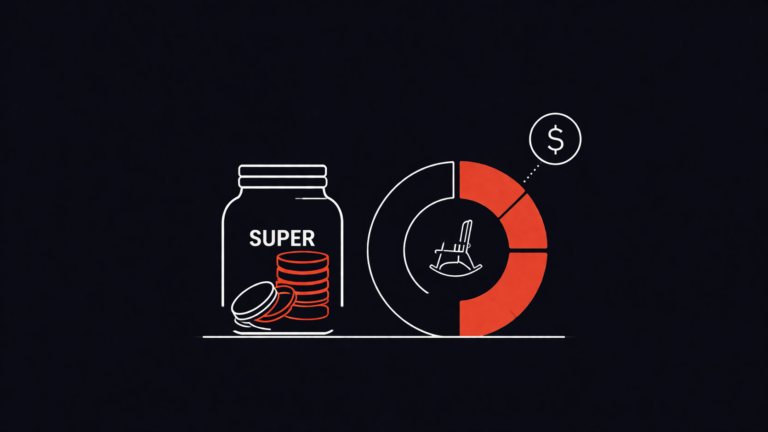
Superannuation balances. The Liberation Day announcement in April 2025 triggered a sharp fall in global equities. Australian super funds with significant exposure to global shares saw meaningful short-term declines. The average superannuation balance for Australians aged 65–69 was approximately $428,000 at the time — meaning market volatility of the kind triggered by tariff announcements translates directly into retirement savings fluctuations. See our superannuation balance guide for context on where most Australians’ balances sit.
The China knock-on. This is the largest indirect risk and the one least discussed in domestic coverage. The United States is not Australia’s primary export market for commodities — China is, by a large margin. Iron ore, coal and liquefied natural gas account for the bulk of Australia’s export income. If US tariff policy slows Chinese manufacturing — which it did materially in 2025 — demand for Australian resources falls. Lower Chinese demand for Australian minerals reduces national income, tax receipts and the terms of trade. That indirect channel is structurally more significant to the Australian economy than the direct impact of the 15 per cent surcharge on goods shipped to the US.
Fuel and interest rates. The Middle East conflict that has driven petrol prices above $2.30 per litre is partly connected to the broader environment of geopolitical instability in which US trade policy operates. The RBA has explicitly cited global trade uncertainty as an upside risk to Australian inflation. In that sense, US tariff policy is one ingredient in the same inflationary mix that drove the two consecutive rate hikes in February and March 2026. For more on both of those connected issues, see our petrol prices explainer and RBA rate rise guide.
Australia’s Response — What the Government Has Done
The Australian government has taken a deliberately non-retaliatory position. Prime Minister Albanese’s response after Liberation Day — describing the tariffs as “not the act of a friend” with “no basis in logic” — did not include any countervailing trade measures against US goods entering Australia.
The government’s concrete actions have been:
- A $50 million assistance package to help affected sectors — primarily beef and agriculture — pursue alternative export markets
- Strengthened anti-dumping provisions on steel and aluminium, aimed at preventing third countries from dumping goods into Australia that were displaced from US markets by tariff barriers
- Continued diplomatic engagement through DFAT and Austrade, including direct representation to the US Trade Representative in relation to the Section 301 investigations
- Austrade’s Go Global Toolkit has been updated with sector-specific guidance for exporters navigating the new tariff environment
What the government has explicitly not done is change the Pharmaceutical Benefits Scheme pricing in response to US pharmaceutical industry pressure — a significant policy line it is holding against ongoing lobbying.
FAQ
Does the US tariff apply to Australian beef?
Currently, no. Australian beef exports up to the combined AUSFTA quota of 449,482 tonnes per year remain tariff-exempt. This exemption was confirmed under the new surcharge framework. However, sheepmeat and goatmeat exports now face the 15 per cent rate. The situation remains subject to change and exporters should monitor DFAT updates.
What is the current US tariff rate on Australian goods?
Most Australian goods now face a 15 per cent Temporary Import Surcharge, introduced by President Trump after the US Supreme Court struck down the original IEEPA-based tariffs in February 2026. Steel and aluminium face a separate 25 per cent Section 232 tariff. Automobiles face 25 per cent. Some goods are exempt. The surcharge can remain in place for up to 150 days under its current legislative authority.
Will there be higher tariffs on Australian goods after July 2026?
Possibly. Two Section 301 investigations launched in March 2026 are expected to conclude in July 2026. These could result in targeted, country-specific tariffs depending on findings. The pharmaceutical sector faces the most significant proposed tariff threat — with figures of 150 to 250 per cent discussed by the US administration. This remains a proposal, not current policy.
Should I be worried about my superannuation?
Superannuation funds are long-term investments and have historically recovered from periods of market volatility including the 2009 financial crisis and COVID-19. Short-term balance movements driven by tariff-related market uncertainty reflect sentiment, not structural changes to the underlying assets. Speaking to your fund or a financial adviser before making changes to your investment options is advisable.
Has Australia retaliated with tariffs on US goods?
No. The Australian government has taken a non-retaliatory position, focusing instead on diplomatic engagement and market diversification support. The government has strengthened anti-dumping rules for steel and aluminium to prevent market distortion from displaced goods, but has not imposed tariffs on US imports.
Conclusion
US tariffs on Australia in 2026 are a shifting and legally contested landscape. The current operative rate for most Australian goods is 15 per cent — but beef, by far the largest export, remains exempt. The greater risk lies ahead: two Section 301 investigations concluding in July could produce more targeted and more damaging tariffs. For everyday Australians, the direct impact runs through export sectors, supply chains, superannuation volatility and — via China — the demand outlook for the resources sector that underpins much of Australia’s national income. The situation warrants attention, not panic.
This article is for informational purposes only and does not constitute financial, legal, or trade advice. Tariff rates, exemptions and trade policy are subject to rapid change. Information is sourced from publicly available Australian government sources including DFAT and ABS data current at time of publication. Exporters should seek independent legal and customs advice specific to their product and market.