SC 189 Skilled Independent Visa Australia 2026: Points, Invitation Cutoffs and How to Apply

The Subclass 189 Skilled Independent visa is Australia’s most competitive skilled migration pathway — and the most rewarding. It grants permanent residency from day one, with no employer needed, no state government required, and no regional living conditions attached. You score points, submit an Expression of Interest, and wait for an invitation. If your score is competitive enough, you get to live and work anywhere in Australia permanently.
The challenge in 2026 is that the bar is high and getting higher for many occupations. This guide covers exactly what you need — eligibility, the points threshold that actually gets invitations, the occupation list, costs, processing times, and what to do if your score is not yet competitive.
Disclaimer: This article is general information only and does not constitute migration advice. Invitation cutoffs, occupation lists and processing times change each round. Consult a Registered Migration Agent (MARN) for advice specific to your circumstances.
At a glance
| Visa type | Permanent residency — from day one of grant |
| Who it’s for | Skilled workers in eligible occupations who score enough points |
| Minimum points to submit EOI | 65 |
| Realistic points needed for invitation | 85–95+ depending on occupation |
| Occupation list | Medium and Long-term Strategic Skills List (MLTSSL) |
| Skills assessment | Required before lodging EOI |
| No sponsorship needed | No employer, no state, no family member required |
| Processing time | 5–15 months from invitation to grant |
| Application fee (primary) | $4,640 AUD (2025–26) |
| Where to apply | SkillSelect then ImmiAccount |
What is the SC 189 and why is it so competitive?
The Subclass 189 is the only skilled migration visa that grants Australian permanent residency purely on merit — no strings attached. There is no requirement to work for a specific employer, live in a specific region, or have a state government sponsor you. Once granted, you can live, work and study anywhere in Australia, access Medicare, sponsor eligible relatives, and work toward citizenship.
The 189 visa is designed for skilled professionals whose occupations are in demand and who can demonstrate their value through the points test — without needing sponsorship from an employer, a state or territory government, or a family member.
That freedom is exactly why it is so competitive. Every skilled migrant who can possibly score enough points wants the 189. The occupation pool for accounting alone has over 15,000 active EOIs. For IT roles the competition is similarly intense. Scores that would have comfortably received an invitation three years ago are now sitting in the pool unactioned.
Eligibility requirements
To receive an invitation for the SC 189 you must meet all of the following at the time of invitation:
Occupation: Your nominated occupation must be on the Medium and Long-term Strategic Skills List (MLTSSL). The MLTSSL is more restrictive than the lists used for the 190 and 491 visas — not all occupations eligible for state nomination are eligible for the 189. Check the current list at immi.homeaffairs.gov.au before submitting your EOI.
Skills assessment: You must hold a positive skills assessment from the relevant assessing authority for your nominated occupation. The assessment must be valid at the time of invitation. Processing times vary by authority — typically 4 to 12 weeks, but can be longer for some bodies.
Age: You must be under 45 years old at the time of invitation — not at the time of EOI submission. If you submit your EOI at 44 and are invited after your 45th birthday, you are no longer eligible.
English language: You must have at least Competent English — IELTS 6.0 in each band or equivalent on PTE Academic, TOEFL iBT, Cambridge or OET. Competent English earns zero additional points but is the minimum required to submit an EOI. Superior English (IELTS 8.0 in each band) earns 20 points.
Points: You must score at least 65 points on the Australia points test. See the full category breakdown below.
Health and character: Medical examination with a DHA-approved panel physician and police clearances from every country lived in for 12 or more months in the past 10 years.
Points required for an invitation in 2026
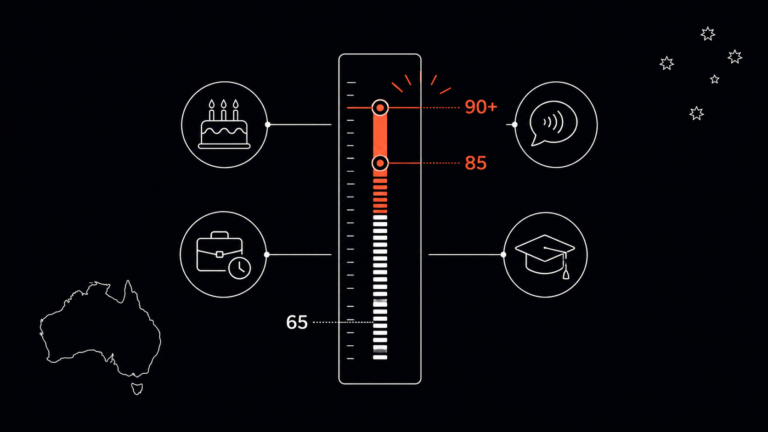
The minimum to submit an EOI is 65 points. The minimum to actually receive an invitation is significantly higher. In practice, most successful 189 applicants in 2025–26 have needed 85 to 95+ points depending on their occupation.
The DHA introduced a tiered occupation multiplier system for 189 invitations from the 2026 program year. Your tier determines how many invitations your occupation receives, not just your points score.
Occupation tiers and 2026 invitation cutoffs
Tier 1 — Critical health shortages (invited at lowest cutoffs, 65–75 points): Registered Nurses, GPs, Medical Specialists, Allied Health professionals including Physiotherapists, Occupational Therapists, Pharmacists, Paramedics, Optometrists, Dentists, Midwives, Speech Pathologists.
Tier 2 — Education and social services (invited at 75–85 points typically): Secondary and Primary Teachers, Early Childhood Teachers, Psychologists, Counsellors, Social Workers, Welfare Workers.
Tier 3 — Engineering, trades and sciences (cutoffs 65–90 points depending on occupation pool size): Civil, Mechanical, Electrical and Mining Engineers. Trades including Bricklayers, Carpenters, Plumbers — these received invitations at the 65-point minimum in 2025–26 rounds.
Tier 4 — Accountants, ICT and software engineers: Accountants have not received 189 federal invitations in the 2026 program year to date. The accountant EOI pool has over 15,240 applicants. IT professionals and software engineers face cutoffs of 90+ points.
The practical implication: If you are in Tier 4 (accounting, general IT), the 189 federal pathway is effectively closed for you in 2026 unless you score 90+. The recommended strategy is to pursue state nomination through the SC 190 or the regional pathway through the SC 491 in parallel, not to wait solely on the 189 pool.
The invitation round system in 2026
From 2026, the DHA moved from irregular monthly or ad-hoc rounds to quarterly scheduled rounds. This means fewer invitation opportunities per year but larger rounds when they occur. Missing a round adds three months to your wait time — making EOI timing significantly more consequential than before.
When two applicants have the same points score, the DHA uses the date of effect — the date you first reached that score — as a tiebreaker. This means lodging your EOI as soon as your score is established gives you queue priority over equally-scored applicants who lodge later.
After two rounds in the 2026 program year, total invitations were 16,887 against a planning level of approximately 16,900 — suggesting limited or no remaining rounds may be issued for the 2026 program year. Check the DHA SkillSelect invitation rounds page for the latest confirmed round data.
Points categories — full breakdown
For a complete breakdown of every points category and how to maximise your score, see the Australia points test 2026 guide. In summary:
| Category | Maximum points |
|---|---|
| Age (25–32 = 30 points) | 30 |
| English (Superior = 20 points) | 20 |
| Work experience — overseas + Australian combined | 20 |
| Qualifications (PhD = 20 points) | 20 |
| Australian study | 5 (+ 5 if regional) |
| STEM Masters/PhD | 10 |
| Professional Year | 5 |
| NAATI CCL | 5 |
| Partner skills | 10 |
| Theoretical maximum | 125 |
No state or territory nomination bonus applies to the 189 — that +5 is only available on the SC 190 and the +15 is only on the SC 491.
What rights does the SC 189 grant?
Unlike the SC 482 or SC 485, the 189 grants permanent residency from day one of the visa being granted. From grant date you can:
- Live and work anywhere in Australia permanently — no regional conditions, no employer restrictions
- Work for any employer in any occupation
- Access Medicare — Australia’s public healthcare system
- Enrol children in Australian public schools at domestic fee rates
- Study in Australia at domestic fee rates
- Sponsor eligible family members for certain visas
- Travel in and out of Australia freely for five years from the grant date (after which a Resident Return Visa or citizenship is needed for re-entry)
- Apply for Australian citizenship after meeting the four-year residence requirement (one year as a permanent resident)
How much does the SC 189 cost?
| Fee | Amount (2025–26) |
|---|---|
| Primary applicant | $4,640 |
| Secondary applicant aged 18+ | $2,320 |
| Secondary applicant under 18 | $1,160 |
Additional costs: skills assessment fee (varies by authority, typically $300–$2,800), English test ($330–$430), medical examination ($300–$500 per person), police clearances ($50–$200 per country). The total cost for a couple including skills assessment, English test, medicals and the visa fee is typically $8,000–$12,000.
All visa fees are payable at the time of lodging the full application through ImmiAccount after receiving an invitation. There is no fee to submit an EOI.
How to apply: step by step
Step 1 — Skills assessment Obtain a positive skills assessment from the relevant assessing authority for your nominated occupation. Common authorities include Engineers Australia (engineering), VETASSESS (range of professional occupations), ACS (IT), CPA/CAANZ (accounting), AHPRA (health professions) and TRA (trades). Processing times vary — allow 4–12 weeks minimum.
Step 2 — English test Book and complete your English language test if you haven’t already, or confirm your existing result is within the 3-year validity period. Aim for IELTS 8.0 in each band (Superior) — the 10-point gap between Proficient and Superior is the single highest-leverage action available to most applicants.
Step 3 — Submit an EOI through SkillSelect Log into SkillSelect and submit your Expression of Interest. There is no fee. Your EOI enters the pool where it is ranked by points score within your occupation. You can update your EOI at any time — but note that updating resets your queue position, which can disadvantage applicants whose score is close to the cutoff.
Step 4 — Wait for an invitation The DHA runs quarterly invitation rounds. If your score is competitive, you will receive an invitation to apply for the visa through ImmiAccount. You have 60 days from the invitation date to lodge the full application.
Step 5 — Lodge the visa application Through ImmiAccount, pay the application fee and upload all supporting documents including your skills assessment, English test results, identity documents, and health and character clearances.
Step 6 — Complete health examinations and police clearances Complete your medical examination at a DHA-approved panel physician after lodging. Obtain police clearances from every country lived in for 12+ months in the past 10 years.
Step 7 — Await the decision Respond to any DHA requests promptly. Most processing occurs within 5–15 months from lodging the full application. Decision-ready applications process faster.
Processing times
| EOI pool wait (before invitation) | Varies — weeks to 12+ months depending on occupation and points |
| Full application processing | 5–15 months from lodging |
| Total realistic timeline | 8–24 months from EOI submission to grant |
Processing time begins from the date you lodge the full visa application — not from when you submitted your EOI. Decision-ready applications with complete documentation and prompt responses to DHA requests process at the faster end of the range.
SC 189 vs SC 190 vs SC 491 — which pathway is right for you?
The 189 is the cleanest outcome but the hardest to achieve. Before deciding to wait in the 189 pool, assess whether the 190 or 491 is a more practical path to your PR goal.
| SC 189 | SC 190 | SC 491 | |
|---|---|---|---|
| Sponsorship | None needed | State/territory government | State/territory or family |
| Points bonus | None | +5 | +15 |
| PR on grant | Yes — immediate | Yes — immediate | No — provisional, PR via SC 191 after 3 years |
| Where you can live | Anywhere in Australia | Preferred state (2-year commitment) | Designated regional areas only |
| Best for | High scorers 85–95+ in health, education, trades | Mid scorers or Tier 4 occupations | Lower scorers willing to live regionally |
For a full comparison of how to build your points score across all three pathways, see the Australia points test 2026 guide. For state nomination details, see SC 190 State Nomination 2026. For the regional pathway with the 15-point bonus, see SC 491 Skilled Work Regional 2026.
What to do if your points score is not competitive enough
If your base score is below what your occupation requires for a 189 invitation, these are the highest-leverage actions:
Retake your English test (+10 points): Moving from Proficient (IELTS 7 in each band) to Superior (IELTS 8 in each band) adds 10 points. This single action has the highest points-per-effort ratio of any available strategy.
Get a NAATI CCL result (+5 points): If you speak a community language, the NAATI Community Language Credentialing test adds 5 points. Available in Hindi, Mandarin, Arabic, Punjabi, Tagalog, Tamil, Vietnamese and many others.
Gain Australian work experience (+5–15 points): Every year of skilled work experience in Australia in your nominated occupation adds points, up to the combined 20-point cap. If you are on a SC 482 employer-sponsored visa or a SC 485 graduate visa, every year you work counts.
Apply for state nomination — SC 190 (+5 points): The SC 190 adds 5 points to your existing score and may unlock invitation rounds in your occupation that the 189 pool does not offer. See the SC 190 guide.
Consider the SC 491 (+15 points): If you are open to living in a regional area, the 491 adds 15 points — the largest single boost available. It converts most mid-range scores into competitive ones. See the SC 491 guide.
Frequently asked questions
Do I need a job offer for the SC 189?
No. The Subclass 189 is completely independent — you do not need a job offer, employer sponsorship, or state nomination. Your application is assessed entirely on your points score.
Can I include my family?
Yes. You can include your spouse or de facto partner and dependent children in your application. Each adult secondary applicant incurs an additional $2,320 fee, each child under 18 incurs $1,160.
How long does the EOI stay active?
Two years from the date of submission. If you are not invited within two years, your EOI expires and you must resubmit. You can update your EOI at any time — but be aware that updating resets your queue position.
Can I have EOIs for both 189 and 190 simultaneously?
Yes. Many applicants lodge EOIs for both the 189 and 190 simultaneously to maximise their chances of receiving an invitation. Official invitation round dates are rarely announced in advance — check the DHA SkillSelect page for current round results.
What if I age up during the wait?
Points are calculated at the time of invitation, not EOI submission. If you turn 33 after submitting but before being invited, your age points drop from 30 to 25. If you turn 45 before being invited, you become ineligible regardless of your score.
Is the SC 189 still worth pursuing for IT and accounting?
For accounting specifically, the 2026 data suggests federal 189 invitations are effectively unavailable without a very high score. For IT, cutoffs of 90+ mean you need Superior English plus maximum Australian work experience plus additional bonuses. Both occupations should be pursuing SC 190 state nomination or SC 491 in parallel rather than relying solely on the 189.
This article is general information only. It does not constitute migration advice. Points cutoffs, occupation lists and invitation rounds are subject to change each round. Consult a Registered Migration Agent registered with the Migration Agents Registration Authority (MARA) for advice specific to your circumstances.
Sources: Department of Home Affairs — SC 189 | DHA SkillSelect invitation rounds | DHA skill occupation list