Working Holiday Visa Tax Australia 2025–26: Rates, Rules and How to Get Your Refund

If you are in Australia on a Subclass 417 Working Holiday or Subclass 462 Work and Holiday visa, a specific set of tax rules applies to every dollar you earn — regardless of how long you stay or which state you work in. The rate is lower than what most non-residents pay, but there is no tax-free threshold, and if your employer is not registered correctly with the ATO, you will be overtaxed from day one.
This guide covers the 2025–26 WHM tax rates, what your employer needs to do, how superannuation works, what you can claim as deductions, and how to lodge your tax return and get a refund before leaving Australia — all sourced from the Australian Taxation Office.
Disclaimer: This article is general information only and does not constitute tax advice. Tax obligations depend on individual circumstances. For advice specific to your situation, consult a registered tax agent or visit the ATO.
At a glance: 2025–26 WHM tax rates
| Income | Tax rate |
|---|---|
| $0 – $45,000 | 15% |
| $45,001 – $135,000 | 30% |
| $135,001 – $190,000 | 37% |
| $190,001 and above | 45% |
| Tax-free threshold | None — tax starts from $1 |
| Medicare levy | Not applicable for most WHMs (see below) |
| Superannuation | 12% employer contribution — claimable via DASP on departure |
| DASP tax rate | 65% on super balance when leaving Australia |
Source: ATO tax rates — working holiday makers
Both the Subclass 417 and Subclass 462 are treated identically by the ATO. The rates above apply to both visas in the same way.
The most important thing: no tax-free threshold
Australian residents pay 0% tax on the first $18,200 they earn each financial year. Working holiday makers do not get this benefit. There is no tax-free threshold for WHMs — every dollar earned is subject to the 15% working holiday tax rate from the first dollar.
This is the single most common misunderstanding among working holiday makers arriving in Australia. If you tick “yes” to the tax-free threshold question on your Tax File Number declaration when starting a job, your employer will withhold tax at the wrong rate and you will face a tax bill — not a refund — when you lodge your return.
Always tick “No” to the tax-free threshold question on your TFN declaration when starting work as a WHM.
For context on how the WHM rate compares to standard Australian resident tax rates, see Australia tax rates 2025–26 and ATO tax brackets 2026–27.
Your employer must be registered with the ATO
This is the second most important thing to understand. If your employer is registered with the ATO as a WHM employer, they withhold tax at the 15% rate on the first $45,000 you earn. If they are not registered, the default withholding rate is 32.5% from the first dollar.
The 32.5% rate is the standard foreign resident tax rate — more than double the WHM rate for lower incomes. You can recover the difference by lodging a tax return at the end of the financial year, but that means waiting months for money that should have stayed in your pocket.
Before starting any job, ask your employer whether they are registered with the ATO as a working holiday maker employer. They can check their registration status through ATO Online Services for Business. If they are not registered, they must register before they can apply the 15% rate.
If you work for multiple employers in the same financial year, the $45,000 threshold applies per employer — not per person across all jobs. Each employer applies 15% on the first $45,000 they pay you, but your total income from all sources is combined when you lodge your tax return and any income above $45,000 in total is assessed at the higher rates.
What tax do you actually pay? Real examples
Example 1 — Farm work, $25,000 earned: Tax at 15% on $25,000 = $3,750. No Medicare levy (non-reciprocal country). Take-home: $21,250. Plus 12% super = $3,000 paid to your fund (subject to 65% DASP tax when you leave).
Example 2 — Hospitality work, $42,000 earned: Tax at 15% on $42,000 = $6,300. Take-home: $35,700. Employer contributes $5,040 to super.
Example 3 — Income over $45,000, $55,000 earned: Tax on first $45,000 at 15% = $6,750. Tax on next $10,000 at 30% = $3,000. Total tax: $9,750. Take-home: $45,250. This is why most WHMs aim to keep total income per employer under $45,000 if they can.
Comparison with Australian resident at $35,000: An Australian resident earning $35,000 pays approximately $2,488 in tax after the tax-free threshold. A WHM earning $35,000 pays $5,250. The difference — $2,762 — is the real cost of the backpacker tax rate versus standard resident rates for lower incomes.
Do you pay the Medicare levy?
Working holiday makers are generally not eligible for Medicare, so they are not subject to the 2% Medicare levy. Some exceptions apply if you hold citizenship or permanent residency from a country with a Reciprocal Health Care Agreement with Australia and are eligible for Medicare.
Countries with Reciprocal Health Care Agreements include the United Kingdom, Ireland, New Zealand, the Netherlands, Sweden, Finland, Norway, Belgium, Slovenia, Malta and Italy. If you are from one of these countries and accessing Medicare, the 2% levy applies on top of the 15% WHM rate. For the full list and what each agreement covers, see Medicare levy for visa holders 2025–26.
Do you need to lodge a tax return?
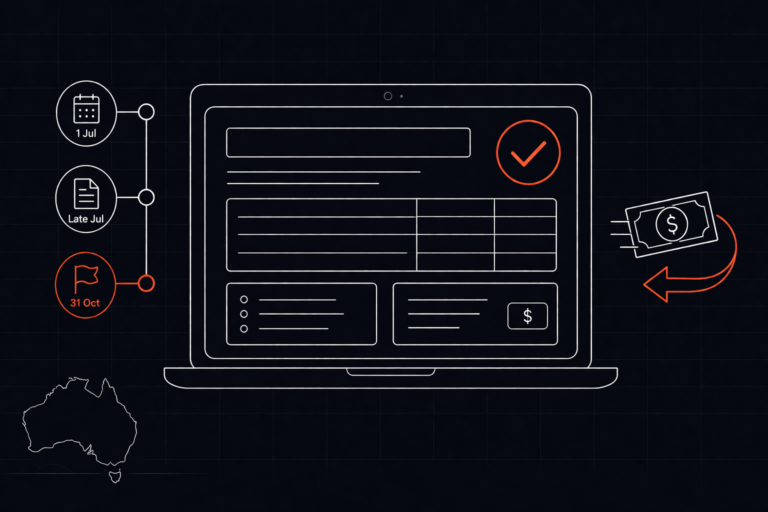
Yes — if you earned any Australian income during the financial year, you are required to lodge an Australian tax return with the ATO. The Australian financial year runs from 1 July to 30 June. The tax return deadline is 31 October each year.
You should lodge a tax return even if you have already left Australia, because:
- Your employer may have withheld too much tax — particularly if they withheld at 32.5% instead of 15%, or if you earned less than expected during the year
- You may have claimable deductions that reduce your taxable income and increase your refund
- The ATO requires it regardless of whether you expect a refund or owe money
You can lodge your return online through myTax via myGov, through a registered tax agent, or through a paper return. If you are outside Australia when lodging, you can still lodge through myTax using your myGov account.
What can you claim as a deduction?
Working holiday makers can claim work-related deductions in the same way as any other worker in Australia. These reduce your taxable income and increase your refund. Common claimable deductions include:
- Tools and equipment purchased for work and used in earning income
- Protective clothing and footwear required for your specific job — steel-capped boots for farm or construction work, for example
- Uniforms or work-specific clothing (not general clothing that can be worn outside work)
- Travel costs between two separate jobs on the same day — not travel from home to your first job
- Union fees and professional memberships
- Phone and internet costs directly related to earning income — the portion used for work only
- Tax agent fees for preparing and lodging your return
You cannot claim the cost of travel from home to your primary workplace, general clothing, or personal living expenses.
Keep receipts and records for all deductions — the ATO can request evidence. The ATO’s myDeductions tool within the ATO app lets you photograph receipts and log expenses throughout the year.
How to get your tax file number
You must have an Australian Tax File Number (TFN) to work legally in Australia and to ensure your employer withholds tax at the correct rate. Without a TFN, your employer is required to withhold tax at 45% — the highest rate.
Apply for a TFN through ATO online services before starting work. The TFN application is free. You do not need to visit an ATO office — the application is completed entirely online. Processing typically takes 28 days, but most applications are faster.
Once you have your TFN, complete a Tax File Number declaration form and give it to your employer. On the form:
- Enter your TFN
- Answer “No” to the tax-free threshold question
- Indicate that you are on a working holiday visa
Keep a copy of the completed declaration for your records.
Superannuation: what happens to it when you leave?
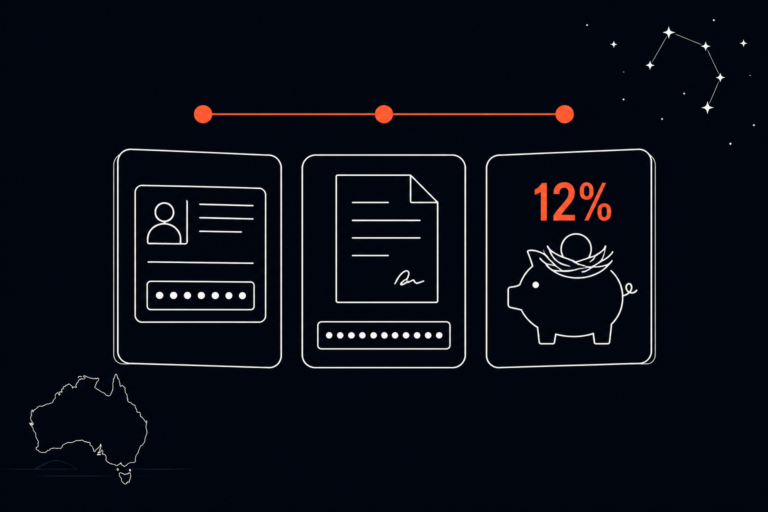
Every employer in Australia must contribute 12% of your ordinary earnings to a superannuation fund on your behalf — this applies to working holiday makers the same as any other worker. You are entitled to superannuation regardless of your visa type or how short your employment is.
When you leave Australia permanently, you can claim your superannuation back through the Departing Australia Superannuation Payment (DASP) scheme.
DASP tax rate: 65%. The DASP is taxed at 65% for working holiday makers — on a super balance of $5,000, you receive approximately $1,750 after tax. This is a high tax rate and is intentional — it reflects Australia’s policy position on WHM superannuation.
To claim DASP you need to:
- Have permanently departed Australia — DASP cannot be claimed while you are in Australia on a valid visa
- Have your visa expired or cancelled
- Apply online through the ATO DASP online application system using your passport, visa details, and TFN
- Provide your super fund name and member number
Processing typically takes 28 days. If you do not claim DASP, your superannuation fund will eventually transfer your balance to the ATO as lost super. You can still claim it later through the ATO’s unclaimed super process, but it adds complexity.
NDA country exception: UK, US and German WHMs
Following a series of court decisions culminating in the Australian High Court in November 2021, working holiday makers from certain countries with Non-Discrimination Article (NDA) treaties with Australia — primarily the United Kingdom, United States and Germany — may in certain circumstances be entitled to be taxed as Australian tax residents rather than at the WHM flat rate.
This is a complex area of tax law with specific eligibility conditions. Affected WHMs from NDA countries who were considered to be tax residents can still claim refunds for 2017–21 if not already processed by the ATO. For current year returns, if you believe you may qualify as an Australian tax resident rather than a foreign resident, consult a registered tax agent before lodging — the ATO’s default position is to apply the WHM rate to all 417/462 holders unless advised otherwise.
What if your visa type changes mid-year?
If you switch from a working holiday visa to another visa type — such as a student visa or skilled worker visa — your tax rate changes from the date the new visa is granted. If you become a tax resident, you get the tax-free threshold and resident marginal rates from that date.
In this case, your income is split at tax return time — WHM rates apply up to the visa change date, resident rates apply from that date forward. This split calculation is done by the ATO when you lodge your return. For details on how tax residency is determined, see the Australian tax residency test 2026.
If you are planning to transition from a WHM visa to a skilled migration visa — for example the Subclass 482 or the student to PR pathway — the tax implications of the visa change date are worth understanding before you lodge your return.
Step-by-step: lodging your WHM tax return
- Gather your income statements — your employer is required to finalise your income statement in the ATO system by 31 July each year. Check yours through myGov linked to the ATO.
- Gather your deduction records — receipts, log books and records for any work-related expenses you plan to claim.
- Log into myGov and access myTax. If you do not have a myGov account, create one at my.gov.au — you can link it to the ATO using your TFN.
- Complete the return. The ATO pre-fills most information from employer reports. Review pre-filled data carefully — check that your employer withheld at 15% and not a higher rate.
- In the tax residency section, confirm you are a working holiday maker and select the correct visa subclass (417 or 462).
- Enter any deductions you are claiming with supporting documentation available if requested.
- Submit the return. Most refunds are processed within 2 weeks for electronically lodged returns.
If you have left Australia, you can still complete the above process online through myGov. If you cannot access myGov from overseas, a registered tax agent in Australia can lodge on your behalf — agent fees are tax deductible in the following year’s return.
Frequently asked questions
Can I work for multiple employers on a working holiday visa?
Yes. There are no restrictions on the number of employers you can work for simultaneously or sequentially. Each employer must be registered with the ATO as a WHM employer and apply the 15% rate on the first $45,000 they pay you. Your total income from all employers is combined when you lodge your tax return.
What if my employer withheld tax at the wrong rate?
Lodge your tax return at the end of the financial year. The ATO will calculate the correct tax based on your total income and WHM status, and refund any excess withheld. If your employer withheld at 32.5% instead of 15% and you earned $35,000, you are likely owed approximately $5,250 back.
Can I extend my working holiday visa to a second or third year?
Yes, subject to completing eligible regional work requirements. Spending 3 months doing specified work in a regional area of Australia makes you eligible to apply for a second 417 visa. A third-year visa is available after a further 6 months of specified work. Tax rules remain the same across all WHM visa years. See the Department of Home Affairs for current regional work requirements.
Is my tax situation different if I am an Australian citizen on a working holiday abroad and I return?
No — if you are an Australian citizen returning to work in Australia, you are a tax resident and the standard resident tax rates and tax-free threshold apply. The WHM tax rate applies only to holders of Subclass 417 and 462 visas.
What if I earn income from cash-in-hand jobs?
All Australian income must be declared in your tax return regardless of how it was paid. Cash income is assessable income under Australian tax law. Employers who pay cash without reporting it to the ATO are also breaking the law — underpayment of workers, including WHMs, is monitored by both the ATO and the Fair Work Ombudsman.
Do I need to lodge a return if I earned very little?
Yes, if you earned any Australian income at all during the financial year. There is no minimum income threshold below which lodgement is not required for WHMs. Lodging a nil return or a small-income return is straightforward through myTax and ensures your ATO records are complete for any future visa applications.
This article is general information only and does not constitute tax advice. Tax obligations for working holiday makers depend on individual circumstances including visa status, residency, income level and employer registration. Consult a registered tax agent or visit the ATO for guidance specific to your situation.
Sources: ATO — working holiday makers | ATO tax rates — WHM | ATO Schedule 15 | ATO DASP