Are Australian Wages Keeping Up With the Cost of Living in 2026?

Australian wages are growing. The question is whether they are growing fast enough to keep pace with the cost of living. Based on the most recent data, the answer is mixed — and depends heavily on which industry you work in.
Here is what the publicly available data shows about wages and the cost of living in Australia in 2026, explained as clearly as I can based on my own research.
What the ABS Wage Price Index Shows
The Australian Bureau of Statistics publishes a Wage Price Index every quarter that measures how wages and salaries are changing across the economy. The most recent data, for the December quarter 2025, shows the following:
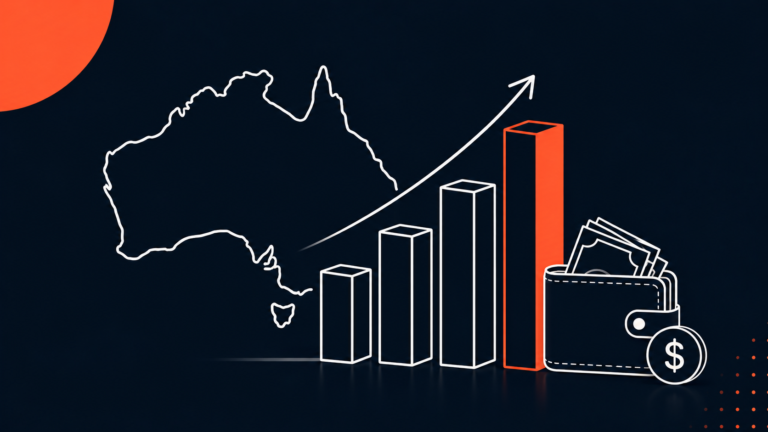
Wages rose 0.8 per cent in the December quarter 2025, the same pace as September quarter 2025. Through the year to December quarter 2025, wages grew 3.4 per cent — up from 3.3 per cent in the September quarter and 3.2 per cent in December 2024.
Private sector wages rose 3.4 per cent annually. Public sector wages grew faster at 4.0 per cent annually, driven by scheduled enterprise agreement increases for frontline healthcare workers.
Are Wages Keeping Up With Inflation?
The short answer is: barely, and only just. Overall CPI inflation was 3.7 per cent in the 12 months to February 2026, according to the ABS. Wage growth of 3.4 per cent means that in real terms — adjusting for inflation — most Australian workers experienced a slight decline in purchasing power over this period.
According to the ABS Wage Price Index, wages grew 3.4 per cent nationally while CPI inflation ran at 3.7 to 3.8 per cent — meaning most workers experienced a modest real wage decline over this period. As one data summary put it plainly: your pay packet has more digits on it than last year but buys less.
The National Minimum Wage in 2026
The Fair Work Commission conducts an annual review of the national minimum wage each financial year, with new rates taking effect from the first full pay period after 1 July.
From 1 July 2025, the national minimum wage increased by 3.5 per cent to $25.05 per hour, or $952.90 per week for a full-time employee working 38 ordinary hours. This followed a 3.75 per cent increase in the 2024 financial year.
For casual employees, the 25 per cent casual loading applies on top of the base rate, bringing the minimum casual hourly rate to approximately $31.31 per hour.
Most Australian employees are not paid the national minimum wage — they are covered by modern awards, which set industry and occupation-specific minimum rates that are typically higher. The 3.5 per cent increase flows through to award wages as well.
Which Industries Are Seeing the Biggest Wage Increases?
Not all workers are experiencing the same rate of wage growth. According to the ABS Wage Price Index for December 2025, health care and social assistance recorded the highest annual wage growth at 4.4 per cent — outpacing national inflation. This reflects Commonwealth-funded initiatives in aged care and early childhood education, as well as scheduled enterprise agreement increases for frontline healthcare workers in New South Wales.
Other sectors with above-average wage growth according to the ABS include mining, utilities, construction, transport and warehousing, and education and training.
Industries with lower wage growth include finance, arts and recreation, retail trade, and professional services — meaning workers in these sectors experienced a more pronounced real wage decline over the past year.
Why Wage Growth Is Slowing
After a period of elevated wage growth driven by labour shortages following the COVID-19 pandemic, wage growth in Australia is now on a moderating path. Westpac’s analysis of the December 2025 ABS data noted that the 0.8 per cent quarterly increase represented a clear step down from the 0.9 per cent outcomes earlier in 2025.
The RBA has consistently assessed that wages growth, while easing, remains strong enough to present ongoing concerns for the inflation outlook — particularly given weak productivity growth across the economy. Productivity growth determines how much of wage growth is genuine improvement in living standards versus cost pressure that feeds into prices.
The RBA predicts wages growth will ease to approximately 3.0 per cent by mid-2026, according to publicly available RBA forecasts. Treasury has a slightly more optimistic forecast of 3.25 per cent for the same period. Both forecasts suggest wage growth will remain above the long-term average of 2.4 per cent through to 2027.
Wages Versus the Cost of Living — The Bigger Picture
To understand whether Australians are genuinely better or worse off, wages need to be measured against the specific costs that households face — not just overall inflation.
Electricity costs rose 37 per cent in the 12 months to February 2026 on an out-of-pocket basis — far outpacing wage growth. Grocery prices rose 3.1 per cent. Rent rose 3.8 per cent. Meals out and takeaway rose 3.7 per cent.
Against a wage growth rate of 3.4 per cent, most of these major cost categories were rising at a similar or faster pace. The households feeling the most pressure are those spending a higher proportion of income on these necessities — including renters, lower-income workers, and those on fixed incomes.
For the full picture on what specific cost categories are doing, see our coverage of grocery prices, rent prices & electricity costs in 2026.
Where Wages Stand in 2026
Based on the most recent ABS data and publicly available research:
The national minimum wage is $25.05 per hour from 1 July 2025, following a 3.5 per cent increase by the Fair Work Commission. Wages grew 3.4 per cent in the year to December 2025 — slightly below overall CPI inflation of 3.7-3.8 per cent over the same period. Health care and social assistance workers saw the strongest wage growth at 4.4 per cent annually. Wage growth is expected to ease to approximately 3.0 per cent by mid-2026 according to RBA forecasts. In real terms, most Australian workers experienced a modest decline in purchasing power over 2025, though the magnitude varies significantly by industry and individual circumstances.
This article is for general informational purposes only and reflects the author’s own research and understanding of publicly available data. It does not constitute financial advice. Data was accurate at the time of writing — always verify current figures directly with the ABS, the Fair Work Commission, and other cited sources.
Related Articles
- Australia Tax Rates 2026 — how your wage is taxed at each income level
- Industries Paying More in 2026 — which sectors are seeing the biggest wage increases
- Gender Pay Gap Australia 2026 — wage differences by gender across Australian industries
- SC 482 Skills in Demand Visa 2026 — salary thresholds for employer-sponsored skilled migrants