

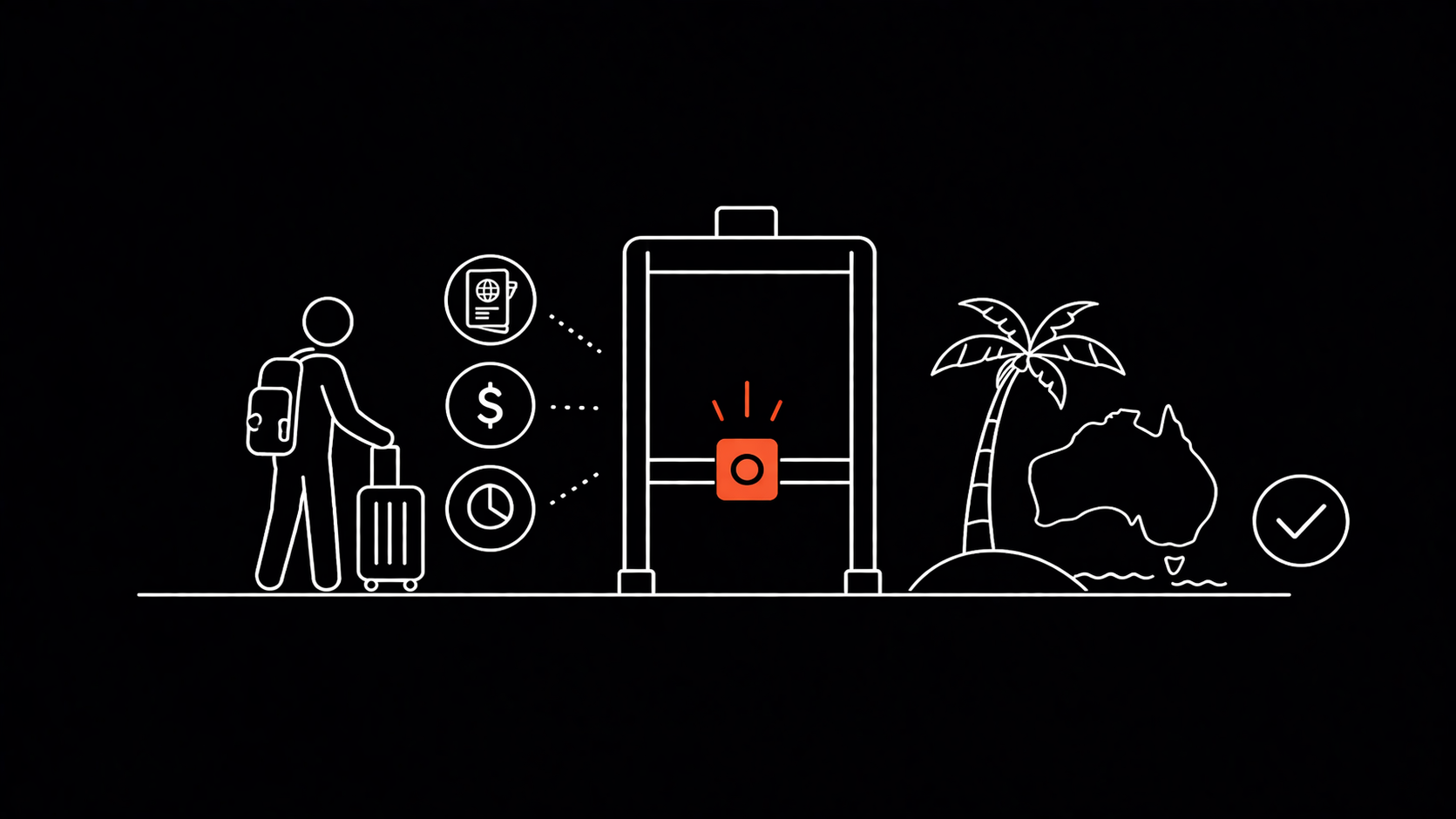
The subclass 600 visitor visa in Australia is the main temporary visa for international travellers who want to visit Australia for tourism, to see family, or for short business activities in 2026. It covers stays of 3, 6, or 12 months and costs approximately $190 to $200 to apply. Most tourist stream applications are decided within 20 to 33 days.
Here is a complete guide to the subclass 600 visitor visa in Australia for 2026, based on publicly available information from the Department of Home Affairs.
Do You Actually Need the Subclass 600?
Before applying for the subclass 600, check whether a simpler visa option applies to you. Australia offers two free or low-cost alternatives for eligible passport holders:
Electronic Travel Authority — ETA (Subclass 601): Available to holders of passports from 37 countries including the US, UK, Canada, Japan, Singapore, South Korea, and most European countries. Costs a $20 service fee and is usually granted instantly through the Australian ETA app. Allows multiple entries with stays of up to 3 months each, valid for 12 months.
eVisitor (Subclass 651): Free for holders of passports from 34 countries — mostly European Union nations. Allows multiple entries with stays of up to 3 months each, valid for 12 months. No service fee.
If your passport is not eligible for the ETA or eVisitor, or if you need to stay longer than 3 months, the subclass 600 visitor visa is your pathway. The subclass 600 also covers sponsored family visits and business visitor activities that the ETA and eVisitor do not formally cover.
The Four Streams of the Subclass 600 Visitor Visa
The subclass 600 visitor visa has four distinct streams. Choosing the correct stream is critical — applying under the wrong stream can lead to delays or refusal.
Tourist Stream
The Tourist Stream is the most commonly used stream and is designed for people visiting Australia for leisure, holidays, sightseeing, or to spend time with family and friends. Most applicants apply under this stream.
Stay period: 3, 6, or 12 months depending on circumstances and supporting evidence. The default grant is typically 3 months — strong evidence of funds and genuine temporary intent supports longer grants.
Business Visitor Stream
The Business Visitor Stream is for short-term business activities that do not constitute employment. Permitted activities include attending conferences and trade fairs, investigating or negotiating business contracts, making general business or employment enquiries, and attending company board meetings.
You cannot accept paid employment, sell goods or services to the Australian public, or perform work for an Australian organisation.
Stay period: Up to 3 months per visit.
Sponsored Family Stream
The Sponsored Family Stream allows Australian citizens, permanent residents, or eligible New Zealand citizens to sponsor eligible relatives to visit Australia. The sponsor may be required to lodge a formal sponsorship and in some cases a financial bond.
Stay period: Typically 3 to 12 months depending on circumstances. Parents sponsored by their children are among those who may be granted longer stays — in some cases up to 3 years for ongoing family visits.
Approved Destination Status Stream
The Approved Destination Status (ADS) stream applies specifically to citizens of China travelling in organised tour groups through approved travel agencies under the Australia-China ADS arrangement. This stream is managed separately from the other three.
Subclass 600 Visitor Visa Requirements in 2026
To be eligible for the subclass 600 visitor visa, you must meet all of the following requirements regardless of which stream you apply under:
Genuine Temporary Entrant (GTE): You must genuinely intend to visit Australia temporarily and leave before your visa expires. The Department assesses your overall circumstances including your travel history, ties to your home country, and the purpose of your visit. Strong home country ties — an ongoing job, owned property, dependent family members, active bank accounts — significantly improve approval chances.
Sufficient funds: You must have enough money to support yourself throughout your stay in Australia and to pay for your return journey home. The Department does not publish a specific minimum figure — evidence of regular income, savings, or financial support from a sponsor is assessed on a case-by-case basis.
Valid passport: Your passport must be valid for at least 6 months beyond your planned arrival date in Australia.
Health and character: You must meet health and character requirements. Some nationalities are required to undergo health examinations. Some visa grants include Condition 8501, which requires you to maintain adequate health insurance for the duration of your stay.
No intention to work or study long-term: You must not intend to seek paid employment or enrol in formal long-term study. Short recreational courses of up to 3 months are permitted on the tourist stream.
Subclass 600 Visitor Visa Fees in 2026
The government visa application charge for the subclass 600 is approximately $190 to $200 AUD for offshore applicants. Onshore applications — lodged while already in Australia — attract different fee rates. Fees are set by the Department of Home Affairs and updated periodically.
Additional costs to budget for include:
- Biometrics: Required for some nationalities — attend an Australian Biometrics Collection Centre
- Health examinations: Required for some nationalities
- Document translation: Required for non-English documents
- Travel insurance: Not legally required for the visa itself but strongly recommended and often expected by case officers
Family members can be included in the same application but each person pays the application fee separately.
Subclass 600 Processing Times in 2026
Processing times vary by stream and application completeness. Based on current 2026 data:
| Stream | 75% of applications | 90% of applications |
|---|---|---|
| Tourist Stream | 20 days | 33 days |
| Business Visitor Stream | 9 days | 20 days |
| Sponsored Family Stream | up to 50 days | — |
The most reliable way to receive a faster decision is to submit a complete, decision-ready application with all required documents at the time of lodgement. Incomplete applications are the most common cause of delays.
Apply at least 4 to 6 weeks before your planned travel date. For sponsored family stream applications, allow longer — up to 2 months.
Applicants from high-volume countries including India, Pakistan, China, and the Middle East may experience processing at the longer end of these ranges.
How to Apply for the Subclass 600 Visitor Visa — Step by Step
Step 1 — Determine the correct stream Identify whether the Tourist, Business Visitor, Sponsored Family, or ADS stream applies to your situation. Using the wrong stream is a common and avoidable cause of refusal.
Step 2 — Gather your documents Prepare your valid passport, recent passport-sized photographs, bank statements or financial evidence, a detailed travel itinerary, accommodation and flight bookings, employment evidence such as a letter from your employer confirming your role and that you have approved leave, and any sponsorship documents if applying under the Sponsored Family Stream.
Step 3 — Create an ImmiAccount Register at immi.homeaffairs.gov.au and create an ImmiAccount. This is the Australian Government’s online visa application portal.
Step 4 — Complete and lodge your application Select the Visitor Visa (Subclass 600) and your stream. Complete all questions accurately. Upload all supporting documents. Pay the application fee of approximately $190 to $200.
Step 5 — Provide biometrics if required If prompted by the Department, attend an Australian Biometrics Collection Centre to provide fingerprints and a photograph. This is required for some nationalities.
Step 6 — Monitor your ImmiAccount The Department will notify you through your ImmiAccount and registered email if additional information is required. Respond promptly — delays in responding to requests are a common cause of extended processing.
Step 7 — Receive your visa grant Once granted, your visa is electronically linked to your passport — there is no physical visa label or stamp required. Keep a copy of your visa grant letter confirming your visa conditions, entry date, and permitted stay period.
Common Reasons for Subclass 600 Refusal
Understanding why visitor visas are refused helps applicants prepare stronger applications. The most common refusal reasons in 2026 are:
Weak ties to home country: The Department is not satisfied you will leave Australia before your visa expires. Counter this with evidence of an ongoing job, owned property, business interests, dependent family members, or other compelling reasons to return home.
Insufficient financial evidence: Bank statements that show inconsistent balances, sudden large deposits, or funds that do not appear to be genuinely the applicant’s own are scrutinised carefully.
Incomplete or inconsistent documents: Missing documents or information that contradicts what is in the application — such as a stated purpose that does not match the itinerary — trigger delays and refusals.
Previous visa overstays or non-compliance: A history of overstaying visas in Australia or other countries significantly affects GTE assessment.
Suspected intention to work or study: If the case officer suspects the genuine purpose of travel is employment or long-term study rather than tourism, the application is likely to be refused.
If your application is refused, you will receive a written refusal notice explaining the reasons. Whether you have the right to request merits review at the Administrative Review Tribunal (ART) depends on where your application was decided — onshore applicants generally have review rights, while most offshore refusals under the tourist stream do not carry an automatic right to ART review. Always check your refusal notice carefully for the specific review rights that apply to your situation.
Extending Your Stay in Australia
Extending a subclass 600 visitor visa stay is possible but not guaranteed. You can apply for a further visitor visa from within Australia before your current visa expires. If you do, you will typically be granted a Bridging Visa allowing you to remain in Australia lawfully while the new application is assessed.
You must provide updated documentation including a clear explanation of why you need to remain longer and any changed circumstances since your original application. Extensions are considered carefully — the Department assesses whether the extended stay is consistent with genuine temporary visitor intent.
You cannot convert a visitor visa into a work visa from within Australia. If you want to change to a work visa, you generally need to do so from outside Australia.
Key Takeaways — Subclass 600 Visitor Visa Australia 2026
The subclass 600 visitor visa costs approximately $190 to $200, allows stays of 3, 6, or 12 months, and processes in 20 to 33 days for the tourist stream. The most important factor in any visitor visa application is demonstrating genuine temporary intent — that you have compelling reasons to return home and sufficient funds to support your stay. If you hold a passport from one of the 37 ETA-eligible or 34 eVisitor-eligible countries, check those options first as they are faster and cheaper.
For those planning to live in Australia long-term rather than visit, see our subclass 189 visa guide for the skilled migration pathway, and our subclass 482 visa guide for the employer-sponsored work visa pathway. For a realistic picture of what living in Australia actually costs, see our cost of living breakdown.
This article is for general informational purposes only and reflects the author’s own research and understanding of publicly available information. It does not constitute immigration or legal advice. Visa rules, fees, and processing times change regularly — always verify current requirements directly with the Department of Home Affairs at immi.homeaffairs.gov.au or through a registered migration agent.