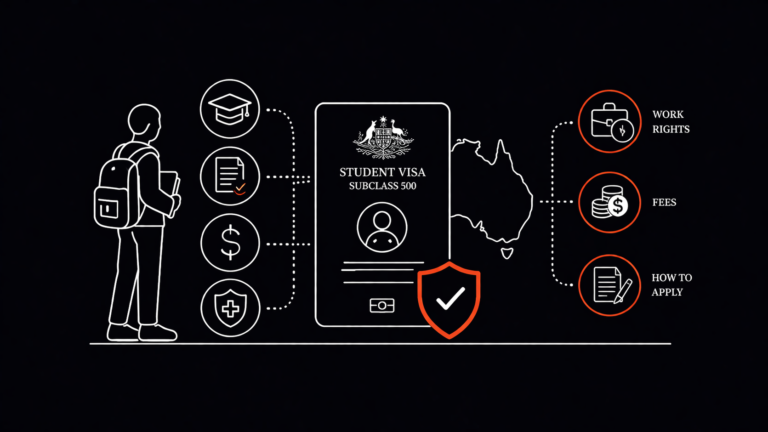


The subclass 485 Temporary Graduate visa in Australia is the most important visa for international students who have just completed their studies and want to stay, work, and build a career pathway toward permanent residency. In 2026, the visa has undergone significant changes including a fee increase, tighter age limits, and updated English requirements that every applicant must understand before lodging.
Here is a complete guide to the subclass 485 Temporary Graduate visa in Australia for 2026, based on publicly available information from the Department of Home Affairs.
What Is the Subclass 485 Visa?
The subclass 485 Temporary Graduate visa is a post-study work visa issued by the Department of Home Affairs that allows eligible international graduates to remain in Australia temporarily after completing their studies. It provides full unrestricted work rights — meaning holders can work in any occupation, for any employer, without needing sponsorship.
The visa is designed as a bridge between study and potential permanent residency. Time spent on the subclass 485 visa builds Australian work experience that strengthens eligibility for skilled migration pathways including the subclass 189 Skilled Independent visa and the subclass 482 Skills in Demand employer-sponsored visa.
The subclass 485 visa does not itself grant permanent residency — it is a temporary visa. But for most international graduates, it is the critical first step in a longer migration journey.
Key Changes to the Subclass 485 Visa in 2026
Several significant changes took effect in 2024 and 2026 that applicants must be aware of:
Fee increase from 1 March 2026: The visa application charge for the subclass 485 increased substantially from 1 March 2026. The new fee for the primary applicant is $4,600 AUD — up from the previous $1,895. Secondary applicants over 18 pay $2,300 and those under 18 pay $1,160. This is one of the most significant fee increases in the recent history of Australia’s student migration pathway.
Age limit tightened to 35: From July 2024, the general age limit for most subclass 485 streams was reduced to under 35 years of age at the time of application. Previously the limit was 50 for most applicants. Exceptions apply for holders of Hong Kong and British National Overseas passports and for graduates with a Masters by Research or Doctoral degree — these applicants retain an age limit of under 50.
English requirements strengthened: The minimum English score for the subclass 485 increased to IELTS 6.5 overall with no individual band below 5.5. The test must have been taken within 1 year before the date of application — previously 3 years was accepted.
Extended work rights for shortage occupations: For graduates in verified skill shortage areas, post-study work rights have been extended. Select bachelor’s degrees now provide up to 4 years, select master’s degrees up to 5 years, and select PhDs up to 6 years of post-study work rights.
The Three Streams of the Subclass 485 Visa
The subclass 485 visa operates across three distinct streams. Your qualification level and study location determine which stream applies to you.
Post-Higher Education Work Stream
This is the most commonly used stream and applies to graduates who hold a degree-level qualification or higher — including bachelor degrees, graduate diplomas, graduate certificates, masters by coursework, masters by research, and doctoral degrees.
No skills assessment is required for this stream. You simply need to demonstrate that you hold the relevant qualification from a CRICOS-registered institution that satisfies the Australian Study Requirement.
Stay period:
- Bachelor degree: 2 years
- Masters by coursework: 2 years
- Masters by research: 3 years
- Doctoral degree (PhD): 3 years
- Hong Kong and British National Overseas passport holders: 5 years across all qualifications
For graduates in select shortage occupations, these periods can extend to 4, 5, or 6 years as noted above.
Post-Vocational Education Work Stream
This stream applies to graduates who hold an associate degree, diploma, advanced diploma, or trade qualification. Unlike the Post-Higher Education stream, this stream requires the nominated occupation to be on the Medium and Long-term Strategic Skills List and a positive skills assessment from the relevant assessing authority.
Stay period: 18 months for most applicants.
This stream is best suited to trade and vocational graduates who want to gain Australian work experience quickly. Given the skills assessment requirement, applicants should begin the assessment process well before completing their studies.
Regional Graduate Stream
This stream is for graduates who studied at an Australian institution located in a regional area and who are still living in that regional area. It provides additional stay time on top of a previous subclass 485 grant.
Stay period: 1 to 2 additional years depending on the regional location of the institution.
This stream is designed to incentivise graduates to remain in regional Australia after their studies, supporting workforce needs outside major capital cities.
Subclass 485 Visa Requirements in 2026
To be eligible for the subclass 485 visa, you must meet all of the following requirements:
Age: You must be under 35 years of age at the time of application for most streams. Exceptions apply for Hong Kong and British National Overseas passport holders, and Masters by Research and PhD graduates who must be under 50.
Location: You must be in Australia when you lodge your subclass 485 application. You cannot apply from overseas.
Student visa history: You must hold an eligible student visa or have held one within the 6 months immediately before your application date.
Australian Study Requirement: You must have completed at least 2 academic years of study at a CRICOS-registered Australian institution. Your course must have been full-time and taught in English. Online study completed under special COVID arrangements does not count toward the requirement.
English language: You must provide a valid English test result showing a minimum of IELTS 6.5 overall with no individual band below 5.5, or an equivalent score on PTE Academic, TOEFL iBT, Cambridge, or OET. The test must have been taken within 1 year before your application date.
Health and character: You and all included family members must meet health and character requirements including health examinations and police clearance certificates.
Application timing: You must apply within 6 months of completing your studies. Missing this window means you become ineligible — there are no extensions to this deadline.
Subclass 485 Visa Fees in 2026
| Applicant | Fee |
|---|---|
| Primary applicant | $4,600 |
| Secondary applicant 18 or over | $2,300 |
| Secondary applicant under 18 | $1,160 |
The fee is non-refundable if the application is refused. Additional costs include health examinations, police clearance certificates, and any migration agent fees if professional assistance is used.
Pacific Island and Timor-Leste citizens are eligible for a reduced fee — check the Department of Home Affairs website for current reduced rates.
Work Rights on the Subclass 485 Visa
The subclass 485 visa provides full unrestricted work rights — one of its most valuable features. There is no limit on hours worked, no restriction on occupation, and no requirement to have an employer sponsor you. You can work for any employer in any industry anywhere in Australia for the full duration of your visa.
Family members included in your application receive the same unrestricted work rights. Partners can work full-time in any occupation. Dependent children can study at Australian schools and universities.
The visa also allows multiple entry travel — you can leave and re-enter Australia freely during the visa period.
For international graduates, this period of unrestricted work is crucial. The Australian work experience gained on the subclass 485 directly contributes to points in the General Skilled Migration program — particularly the subclass 189 and 190 skilled visa pathways — and helps build the employer relationships that can lead to subclass 482 sponsorship.
How to Apply for the Subclass 485 Visa — Step by Step
Step 1 — Check your eligibility Confirm your age, qualification level, student visa history, and English test validity before lodging. The age limit of 35 catches many applicants by surprise — verify this carefully if you are approaching that age.
Step 2 — Complete your English language test Book and complete your English test if you have not already done so, or confirm your existing result is within the 1-year validity period. IELTS 6.5 overall is the minimum — aim higher if you plan to later apply for skilled migration where stronger English earns additional points.
Step 3 — Obtain a skills assessment if required For the Post-Vocational Education Work stream only, lodge your skills assessment application with the relevant authority before or at the same time as your visa application.
Step 4 — Gather your documents Prepare your passport, visa grant notice, academic transcripts, course completion letter, English test results, and Overseas Visitor Health Cover insurance documents. Ensure your completion letter is on official institution letterhead and signed by an authorised officer.
Step 5 — Lodge your application through ImmiAccount Create or log in to your ImmiAccount at immi.homeaffairs.gov.au and complete the online subclass 485 application. Pay the $4,600 application fee. You must be in Australia at the time of lodgement.
Step 6 — Complete health checks if requested The Department may request a health examination during processing. Arrange this with an approved panel physician promptly — delays in completing health checks are one of the most common causes of extended processing times.
Step 7 — Await visa grant Processing times vary depending on stream and application completeness. Plan your transition from your student visa carefully — if your student visa expires before your 485 is granted, you will be issued a Bridging Visa that allows you to remain in Australia and continue working while the application is assessed.
Pathway from the 485 Visa to Permanent Residency
The subclass 485 visa is explicitly designed as a stepping stone toward permanent residency. Here is how the most common pathways work:
General Skilled Migration (subclass 189 or 190): Australian work experience earned on the 485 visa adds points to your skills migration score. One to two years of Australian work experience in your nominated occupation adds 5 to 10 points — which can be decisive in competitive occupation categories. For a full guide to the points-tested pathway, see our subclass 189 visa guide — Subclass 189 Visa Australia 2026 — Skilled Independent Visa Points Test, Requirements and How to Apply.
Employer Nomination Scheme (subclass 482 then 186): Many 485 visa holders secure employer sponsorship during their post-study work period, transitioning to a subclass 482 Skills in Demand visa. After 2 years on the 482 with the same employer, permanent residency through the subclass 186 becomes available. For a full guide to this pathway, see our subclass 482 visa guide — Subclass 482 Visa Australia 2026 — Skills in Demand Visa Requirements, Salary and Processing Times.
Key Takeaways — Subclass 485 Visa Australia 2026
The subclass 485 Temporary Graduate visa in Australia provides international graduates with full unrestricted work rights for 18 months to 3 years depending on qualification level. The 2026 changes are significant — the fee has increased to $4,600, the age limit has dropped to 35 for most applicants, and the English requirement has tightened to IELTS 6.5. Apply within 6 months of completing your studies and ensure you are in Australia at the time of lodgement.
For graduates planning to make Australia home long-term, understanding the cost of living is essential preparation for the post-study period. See our rent prices guide — Australia’s Rent Crisis in 2026 — What the Data Actually Shows — and our jobs market data — Australia’s Jobs Market in 2026 — What the ABS Data Shows About Employment — for a realistic picture of what to expect.
This article is for general informational purposes only and reflects the author’s own research and understanding of publicly available information. It does not constitute immigration or legal advice. Visa rules, fees, and requirements change regularly — always verify current requirements directly with the Department of Home Affairs at immi.homeaffairs.gov.au or through a registered migration agent.