How the Middle East War Is Hitting Australian Household Budgets — What the Numbers Show

This article examines how sustained increases in global oil prices flow through to Australian household costs — the analysis applies to any major global supply shock, not only the 2026 Middle East conflict.
A war in the Middle East that started on 28 February 2026 has sent shockwaves through the global economy — and Australian households are feeling the impact directly. Petrol prices have surged, the Reserve Bank has raised interest rates twice in two months, and economists are warning inflation could accelerate further before it eases.
Here is exactly what the numbers show about how the conflict is hitting Australian budgets right now.
Petrol Prices Have Surged 50 Cents Per Litre
The most immediate impact has been at the bowser. Since the conflict escalated in late February 2026, petrol prices across Australia have jumped approximately 50 cents per litre — rising from around $1.69 to $2.19 per litre on average, with Sydney and Melbourne reaching approximately $2.58 per litre before the government’s fuel excise cut took effect on 1 April 2026.
The cause is direct: the Strait of Hormuz — the narrow waterway through which approximately 20 per cent of the world’s daily oil supply passes — has been effectively disrupted since early March. Australia imports approximately 90 per cent of its liquid fuel, meaning global oil price shocks flow almost immediately to Australian petrol stations.
The government responded on 30 March 2026 by halving the fuel excise from 52.6 cents to 26.3 cents per litre for three months — saving motorists approximately $19 on a 65-litre tank fill. But even with the excise cut, petrol prices remain significantly above pre-conflict levels.
For a full breakdown of the petrol price situation, see our Australia’s petrol prices in 2026.
Household Budgets Are Already Adjusting
Commonwealth Bank’s weekly credit and debit card data to 27 March 2026 shows Australian households have already begun reallocating their budgets in response to the fuel shock. Transport-related spending has risen sharply as a share of total card spending — driven largely by fuel. At the same time, food and household goods spending has fallen back, and recreation spending has also eased.
CBA Head of Australian Economics Belinda Allen noted that consumers appear to be absorbing higher fuel costs by drawing on savings buffers and pulling back on discretionary spending rather than cutting essentials sharply. But she warned that if oil prices remain elevated, the indirect effects — higher transport costs feeding into the price of goods and services — will become increasingly difficult to avoid.
Inflation Was Already Running Hot — Now It Could Go Higher
Before the conflict started, CPI inflation in Australia was already running at 3.7 per cent annually to February 2026 — above the RBA’s 2 to 3 per cent target band. Westpac economists have estimated that the March CPI — which will capture the full impact of the fuel spike — could rise by 1.0 per cent in a single month, with headline inflation potentially reaching 5.5 per cent year on year by mid-2026.
According to SBS analysis of economist forecasts, a three-month disruption to Strait of Hormuz shipping could see Australian CPI temporarily spike by around 1.5 percentage points at its peak, with GDP running 0.5 percentage points lower by the end of 2026. These are not certainties — they are scenarios that depend on how long the conflict continues.
For more on what was driving inflation before the conflict, see our 5 things getting more expensive in Australia.
The RBA Has Already Raised Rates Twice
The Reserve Bank raised the official cash rate by 25 basis points to 3.85 per cent in February 2026 and again by 25 basis points to 4.10 per cent in March 2026 — back-to-back hikes driven by persistent inflation. For a mortgage holder with a $600,000 loan, the March hike alone adds approximately $91 per month to minimum repayments. Combined with the February hike, that is approximately $180 per month in additional repayments compared to late 2025.
The conflict complicates the RBA’s next decision, due in May 2026. If fuel-driven inflation proves persistent, the case for a third consecutive hike strengthens. Markets are currently pricing in that possibility.
For a full explanation of what the rate hikes mean for mortgages, rents, and savings, see our RBA interest rate rise 2026.
Food Insecurity Is Growing
The cost pressures are not evenly distributed. Foodbank Australia — the country’s largest food relief organisation — reports that one in three Australian households experienced food insecurity in the past year. Food charities are reporting huge surges in demand, with reports of one third of people seeking food relief doing so for the first time.
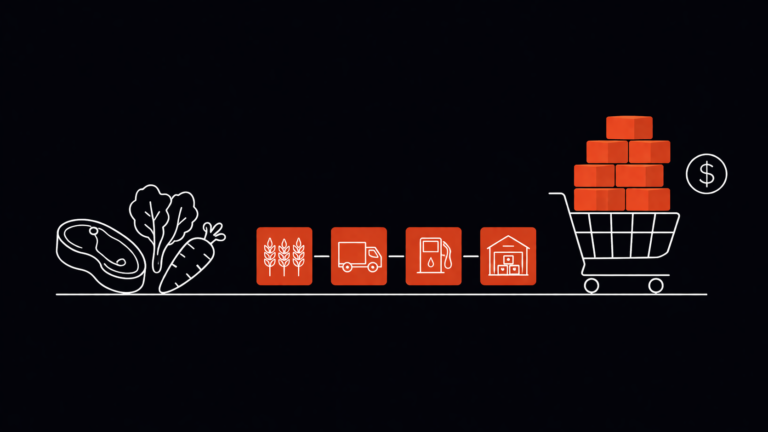
Higher fuel costs compound this pressure indirectly — transport and logistics costs affect the price of every product that moves by road, including fresh food and groceries. Australian grocery prices were already up 3.1 per cent annually to February 2026 before the conflict’s full impact had filtered through.
For more on what is happening to grocery prices, see our Australia’s grocery bill in 2026.
What This Means for Australian Households Right Now
The Middle East conflict has hit Australian household budgets through three simultaneous channels — higher petrol costs, higher mortgage repayments from RBA rate hikes, and rising underlying inflation — all at the same time that electricity bills, rents, and groceries were already at elevated levels.
CBA’s card data shows households are currently absorbing the shock by drawing on savings and cutting discretionary spending. Whether that remains sufficient depends heavily on how long the conflict continues and whether inflation expectations become entrenched.
Oxford Economics, in a prolonged war scenario, estimates Australian GDP could contract 0.3 per cent in the June quarter and a further 0.8 per cent in the September quarter — the sharpest quarterly falls since the early 1990s recession outside of the pandemic. That scenario requires a significantly longer and more damaging conflict than current conditions suggest. But it illustrates the scale of economic risk if the situation escalates further.
For the full picture on wages versus cost of living, see our are Australian wages keeping up.
This article is for general informational purposes only and reflects the author’s own research and understanding of publicly available data. It does not constitute financial advice. Data was accurate at the time of writing — always verify current figures directly with the ABS, RBA, and other official sources.